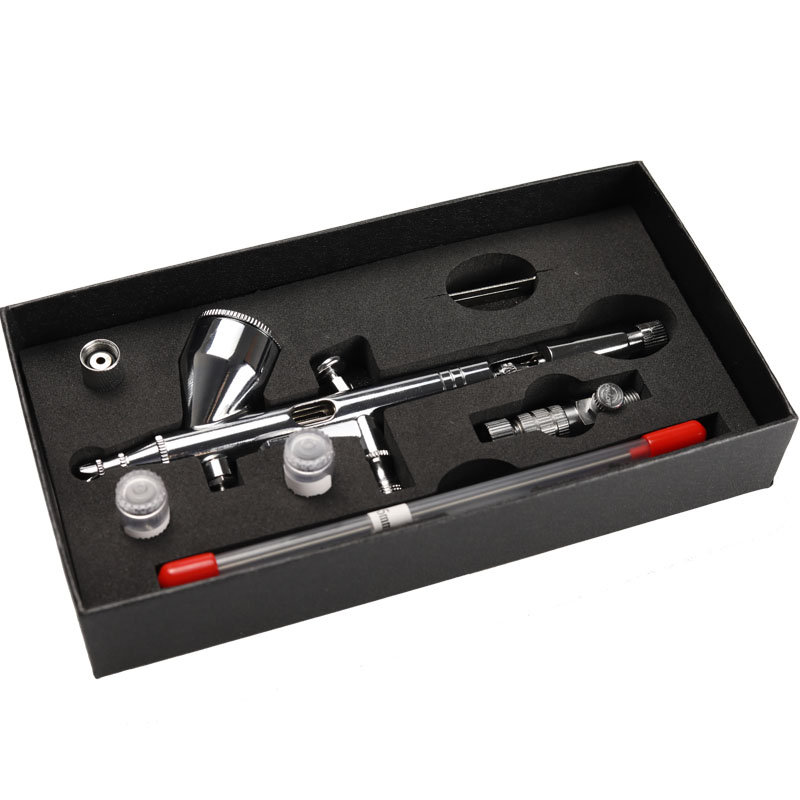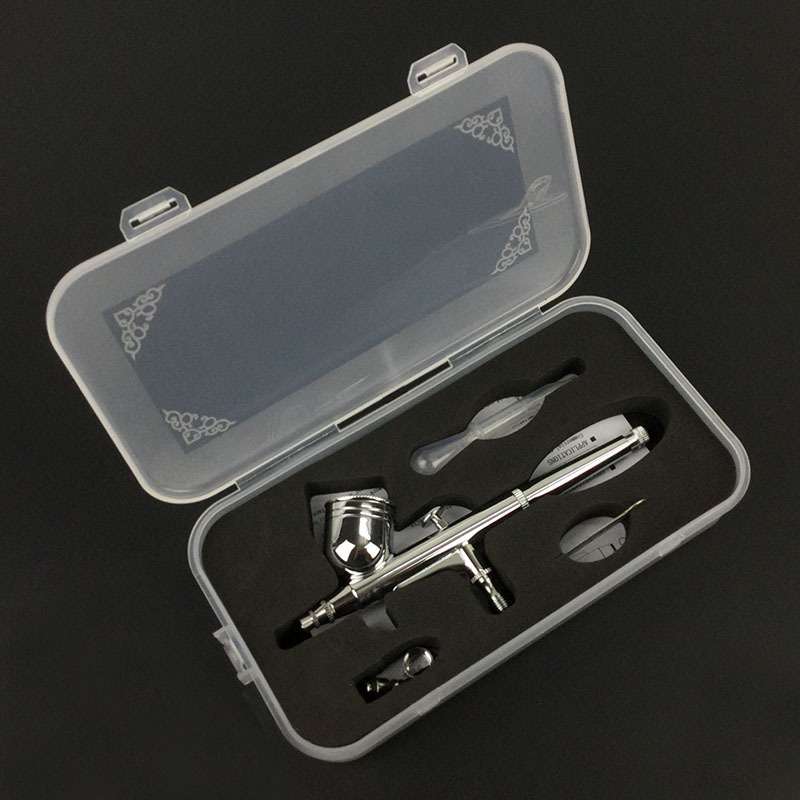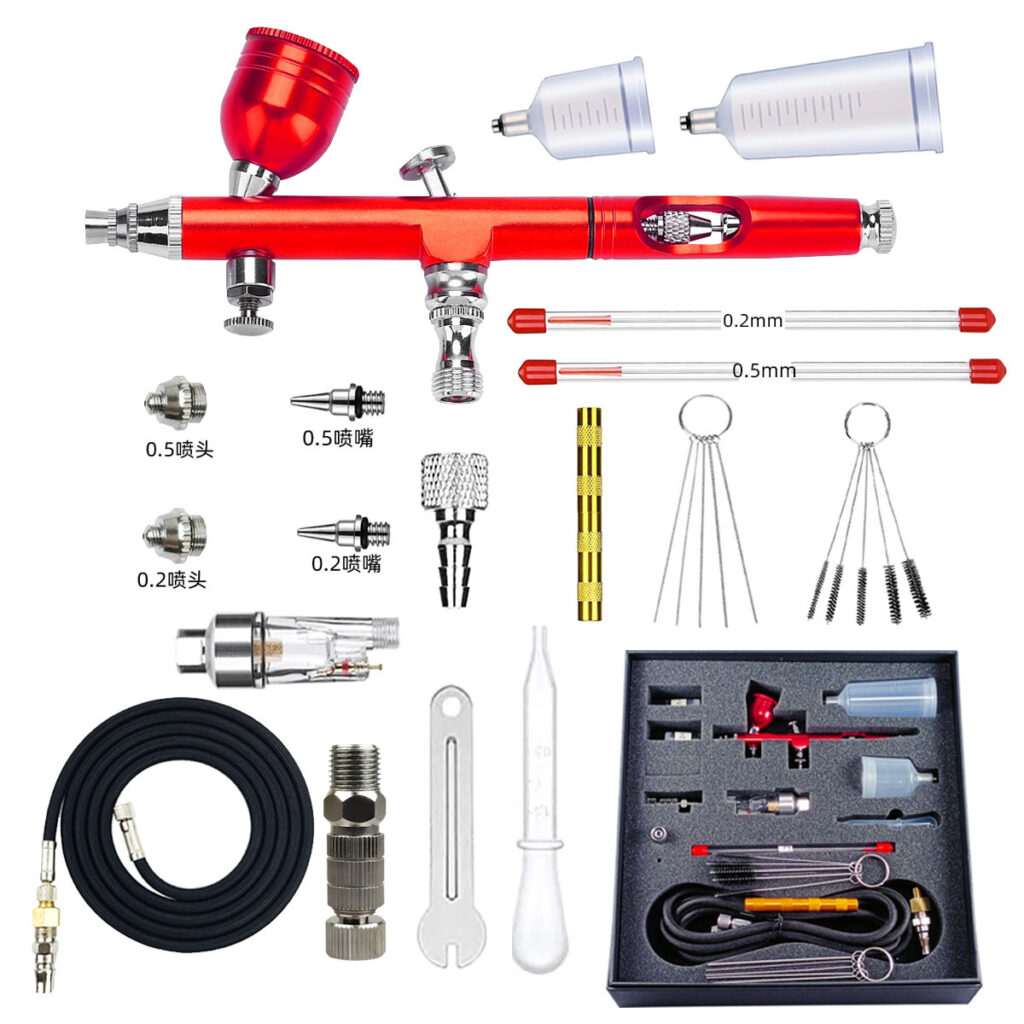
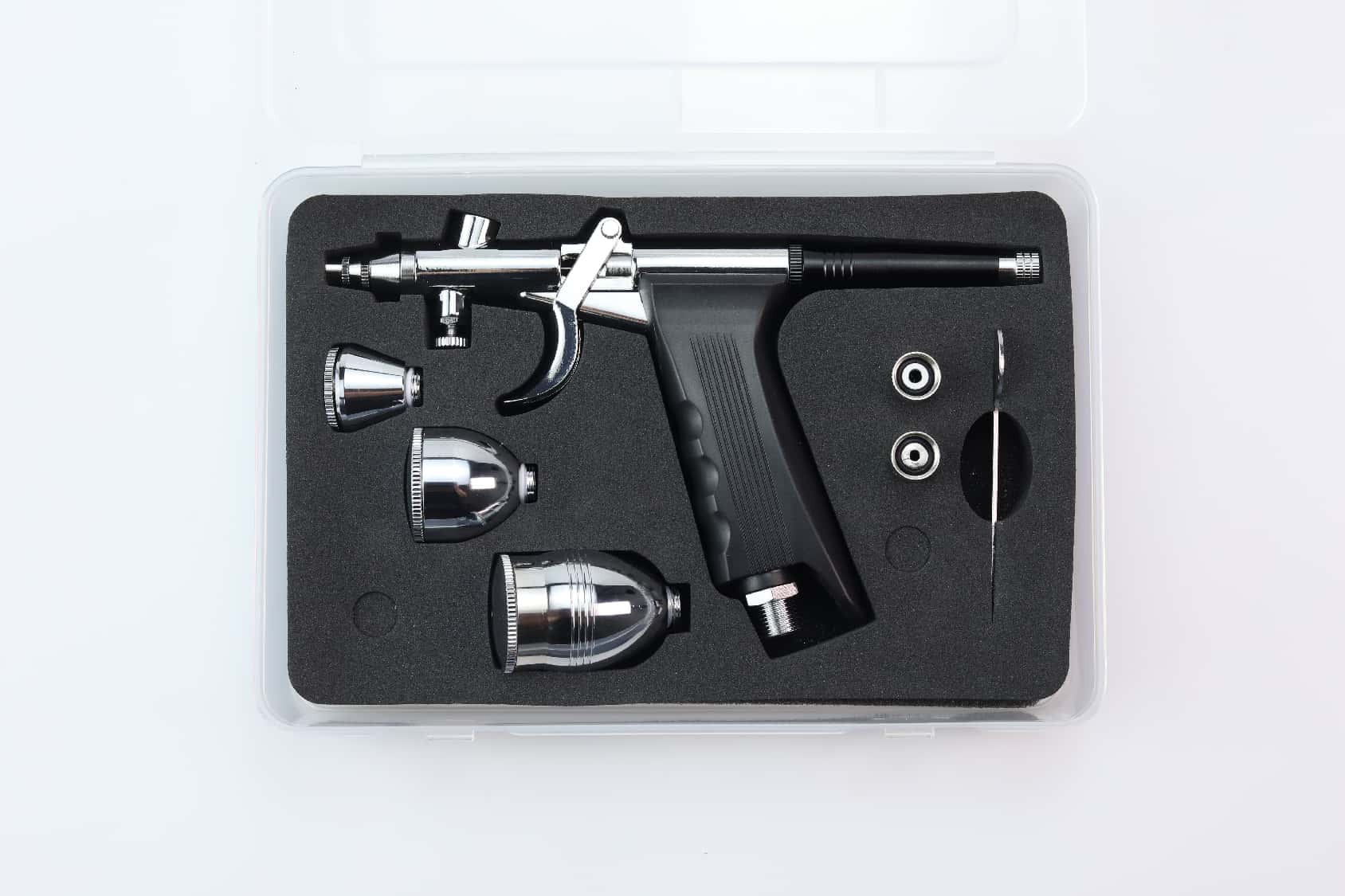
The choice between a gravity feed vs siphon feed airbrush is mainly a choice about material volume, working pressure, color handling and operator workflow. Gravity feed places a cup above the airbrush and is efficient with small quantities and lower pressure. Siphon feed draws from a bottle below the body and is useful when a job needs more material or prefilled bottle changes.
Neither system is universally better. A detail artist, model painter or beauty user may value the small cup and quick rinse of gravity feed. A production decorator, classroom or coverage-focused operator may prefer the capacity and bottle workflow of a bottom-feed airbrush. This guide compares both platforms and shows how brands and distributors can test the right one.
Gravity feed vs siphon feed at a glance
| Decision factor | Gravity feed airbrush | Siphon / bottom-feed airbrush |
|---|---|---|
| Material supply | Top cup assists flow toward the nozzle | Airflow creates suction that draws from a lower bottle |
| Typical pressure behavior | Can often work at lower pressure | Commonly needs more pressure and airflow for pickup |
| Paint capacity | Small to medium cup, suited to limited quantities | Larger bottles suit longer coverage sessions |
| Color changes | Fast rinse for small quantities | Prepared bottles can be swapped quickly; pickup path still needs cleaning |
| Operator view and balance | Top cup may affect sightline depending on size and position | Top remains open, but the lower bottle adds size and weight |
| Common fit | Detail, gradients, small-batch creative work | Coverage, larger volume, repeat colors and multi-user settings |
The table describes workflow tendencies, not guarantees. Cup geometry, nozzle, air cap, bottle seal, pickup tube and compressor all influence the final behavior. Compare complete samples under the same material and task.
Beginner feed type choice for starter kits
Gravity feed vs siphon feed for beginners should start with the first real session, not with the largest accessory list. A gravity cup may be easier to inspect and rinse when a model painter uses a few drops of paint. A siphon or bottom-feed setup can make sense when one color is repeated across a larger batch, but the bottle, vent and pickup tube add more parts to explain and clean.
A beginner airbrush feed type decision should compare the complete kit: reservoir, nozzle, compressor, hose, cleaning path, instructions and replacement parts. If a buyer chooses a bottom-feed option for capacity, verify that the compressor can support pickup under flow and that the bottle path can be cleaned between colors. If a buyer chooses gravity feed for miniatures, connect the choice to the beginner gravity-feed setup and the miniature nozzle guide.
A bottom feed airbrush for model kits is not wrong by category, but it needs a clear reason such as repeated color batches, larger coverage or a classroom workflow. For a first hobby bundle, ask whether the added reservoir parts make the kit easier or harder to support after the first clog, bubble or no-paint report. Use the starter kit checklist to align the feed choice with instructions and service parts.
How a gravity feed airbrush works
A gravity-feed model holds material in a cup above the airbrush body. Gravity helps move it toward the mixing area, so the airflow does not have to lift paint from a lower reservoir. This makes the system efficient with a few drops of material and allows many models to spray at relatively low working pressure.
Integrated cups keep the assembly simple. Removable or interchangeable cups offer capacity choices but introduce a joint that must seal consistently. Cup position matters too: a central cup is familiar and balanced for many users, while side or offset designs can improve the sightline for particular techniques.
Gravity feed is commonly associated with detail, but nozzle and air-cap design still determine line potential. A large cup or 0.5 mm setup can support broader passes, while a 0.2 mm setup can be optimized for fine work. Review the engineering variables in our gravity feed airbrush guide.
How a siphon-feed airbrush works
A siphon-feed airbrush, also called a bottom-feed airbrush, connects a bottle or color cup below the body. Air moving through the head creates a pressure difference that draws material up the pickup tube and into the spray. Reliable pickup depends on sufficient airflow, a clear vent, sealed connections and a clean material passage.
The lower bottle can hold more paint than a small top cup, supporting longer passes without refilling. Operators can prepare multiple compatible bottles and swap them between colors or products. This is valuable only when caps, tubes and seals are controlled; an air leak or blocked vent can stop material flow even when the compressor is running.
Some bottom-feed systems accept both larger bottles and small open color cups. This can widen the workflow, but each reservoir option must be tested with the intended connector and angle.
Pressure and compressor demand
Gravity feed can operate with less pressure because material is already moving toward the nozzle. That helps with close-range control and can reduce overspray when paint is prepared correctly. Siphon feed generally needs more pressure and airflow to lift material from the bottle, especially with a long pickup tube or heavier coating.
This does not create one fixed PSI for either type. Nozzle size, viscosity, air-cap design, hose and spray distance all change the setting. Pressure should be adjusted while air is flowing and verified on a test card. Use the airbrush pressure and PSI guide to select a controlled starting range and diagnose pressure drop.
For a kit comparison, run the same compressor through both airbrushes. Record working pressure at the regulator, pattern stability through a long pass, heat and recovery. A compact compressor that supports a fine gravity-feed setup may not have enough delivered airflow for consistent bottle pickup.
Capacity and refill frequency
A small gravity cup minimizes waste and works well when the user mixes only a few drops. It also makes the remaining material visible. For detailed models, nail work, illustration, touch-up and prototype samples, this can be more useful than a large reservoir.
A siphon bottle reduces refill interruptions during broader coverage or repeated passes. Capacity can help in classrooms, studios and light production, where several prepared bottles may be labeled and stored according to the material supplier’s instructions. The tradeoff is a larger assembly and more residual material in the pickup path.
Do not select capacity from a catalog image. Measure the usable volume at normal operating angles and check whether the bottle changes balance or collides with the work, holder or bench.
Color changes and cleaning time
For small quantities, gravity feed is straightforward: empty the cup, rinse according to the material instructions, flush the passage and verify a clean spray. The open cup is easy to inspect, although dried material around the cup or needle channel still requires attention.
Siphon feed offers a different advantage. Several filled bottles can be exchanged without pouring material into the airbrush. A compatible cleaning bottle can be connected between colors. However, the pickup tube, cap, connector and internal passage retain material, so bottle swapping alone is not a complete clean.
Compare total changeover time from the last pass of one color to a clean first pass of the next. Also count the parts that must be handled. Our airbrush cleaning SOP separates quick color change, end-of-session cleaning and fault-driven deep cleaning.
Detail control, coverage and spray angle
Feed style contributes to control but does not define it alone. Trigger response, needle taper, nozzle alignment, paint preparation and user technique are equally important. A well-made bottom-feed airbrush can produce controlled detail, while a gravity-feed airbrush with a larger nozzle can provide efficient coverage.
Gravity feed often feels natural for close, low-volume work. The operator can reduce pressure and paint flow while keeping the airbrush near the surface. Check whether the cup blocks the view when the tool is held at the intended angle.
Siphon feed keeps the top of the body clear, but the bottle changes the center of gravity. Test vertical, angled and overhead positions carefully. Bottle vents and pickup tubes must stay functional through the claimed operating range; a product should not promise all-angle use unless that configuration has been validated.
Which feed type fits each application?
| Application or workflow | Likely starting platform | Reason to validate the alternative |
|---|---|---|
| Miniatures, scale models and illustration | Gravity feed | Bottom feed may help when repeating one color across larger batches |
| Nail, beauty or small decorative work | Gravity feed | Prepared bottles may support a controlled high-throughput studio process |
| Broad craft, mural detail or larger coverage | Siphon feed | A large-cup gravity model may reduce bottle complexity |
| Classroom or multi-user station | Siphon feed | Gravity feed can reduce material waste in short exercises |
| Frequent small custom colors | Gravity feed | Bottle libraries can be efficient if colors are reused and stored safely |
| Repeated production color | Siphon feed | Gravity feed may improve precision on small components |
The “likely starting platform” is an invitation to test, not a final prescription. Material safety and regulatory rules can override convenience. Food, cosmetic and other sensitive applications need suitable materials, documented cleaning and market-specific compliance.
Nozzle options still determine material tolerance
A feed system cannot compensate for a poorly chosen nozzle. Fine nozzles favor well-filtered, properly reduced materials and controlled detail. Mid-size options balance detail and general coverage. Larger options tolerate heavier material more readily but demand more airflow and may produce a broader pattern.
Compare 0.2, 0.3 and 0.5 mm configurations in our airbrush nozzle size guide. When testing gravity feed vs bottom feed, keep the nozzle family and material preparation as similar as the platforms allow.
Ergonomics, visibility and handling
A gravity cup adds mass above the body. A siphon bottle adds mass below it and may pull on the wrist as material volume changes. Neither balance is automatically more comfortable. Trigger position, body diameter, hose direction and the operator’s grip all affect fatigue.
Ask several target users to complete the same session. Record comfort at the beginning and end, not only the first impression. Check whether the airbrush fits the included holder with the cup or bottle installed and whether users can place it down without leakage.
Retail kit and replacement-part implications
A gravity-feed kit may need a cup lid, dropper, cleaning brushes and protective nozzle tools. A siphon-feed kit may need multiple bottles, caps, pickup tubes, seals and a cleaning bottle. Every extra reservoir must fit securely, survive transport and be identifiable as a replacement part.
For private-label programs, define the bottle material, capacity, thread or connector, gasket and vent design in the bill of materials. Test leakage after transport simulation. The complete airbrush kit supplier checklist covers hoses, fittings, protection, component counts and instructions.
Build the assortment plan around feed type
A gravity vs siphon airbrush assortment plan should avoid treating feed style as a single good-better-best ladder. Gravity feed may be the compact detail option, while siphon feed may support repeated colors, classroom stations or broader craft coverage. Write the use case, reservoir capacity, cleaning path, compressor demand and accessory list beside each SKU before a buyer compares packaging or color.
Use a siphon feed airbrush bottle workflow checklist when the product includes multiple bottles or a bottom reservoir. Confirm cap fit, vent behavior, pickup tube length, seal condition, bottle labeling and cleaning sequence. A fast bottle change is useful only if the first clean pass after the change is repeatable and the shared paint path is not carrying the previous color.
Bottom feed airbrush reorder support also needs a spare-reservoir plan. Define bottle, cap, tube, gasket and connector identity in the same file as the needle, nozzle and hose fittings. Then connect the feed decision to the wholesale reorder risk checklist and the complete kit replacement-parts plan before repeat orders are approved.
Turn feed style into a retail routing decision
A feed system assortment decision record should state why the line includes gravity cup, bottom bottle or both. Put each feed type beside its intended job, reservoir parts, cleanup expectation, compressor demand and spare-part identity so the assortment does not become a list of similar-looking airbrushes.
The bottom feed bottle support path is most useful when the buyer expects prepared colors, classroom stations or repeated coverage. Confirm bottle labels, caps, pickup tubes and cleaning bottles in the same support file, then link user complaints to the cup and backflow guide or no-flow guide before replacing the platform.
A gravity siphon retailer comparison brief should carry the feed decision into the product family list and the buyer brief. Ask for the application, material, session length, color-change pattern and support-part scope; leave price, MOQ and timing to the formal quotation discussion.
Sample test for gravity and siphon platforms
- Use one target coating. Prepare a controlled batch and document reduction, filtration and temperature.
- Normalize the air path. Use the same compressor, regulator, moisture trap and comparable hose whenever possible.
- Set pressure under airflow. Record the lowest stable working PSI for each complete system.
- Run one test card. Compare dots, lines, gradient, broad fill, restart and long-pass stability.
- Measure usable capacity. Record refill frequency, residual material and balance through the session.
- Time color change and cleanup. Include every bottle, cup, cap and pickup component.
- Repeat after reassembly. Confirm that spray and sealing return to the baseline.
- Test multiple units. Approve consistency, not one unusually good sample.
Questions to ask an airbrush manufacturer
- Which gravity and bottom-feed platforms are validated for the target material?
- What working airflow and pressure were used for each sample?
- Which cup and bottle capacities are available, and what is their usable volume?
- How are bottle vents, pickup tubes, cup joints and seals tested?
- Which nozzle and needle replacements will remain compatible for repeat orders?
- Can the manufacturer test the final compressor, hose and fitting combination?
- How are reservoir, power and accessory variations identified during packing?
For broader supplier evaluation, use the OEM airbrush manufacturer audit guide to review machining, sampling, quality control, packaging and repeat-order management.
Gravity vs siphon feed FAQ
Is gravity feed better for beginners?
It is often a practical starting point because it uses small quantities, can operate at lower pressure and is easy to inspect. A forgiving nozzle, clear instructions and matched compressor matter more than feed type alone.
Does siphon feed always use more paint?
The bottle holds more and leaves some material in the pickup path, but actual use depends on the job. For long repeated passes, fewer refill interruptions can make the workflow more efficient.
Can one compressor run both feed types?
Possibly, if it maintains the airflow and working pressure required by both complete setups. Test under load; a maximum-pressure number does not prove sufficient continuous delivery.
Is bottom feed the same as siphon feed?
The terms are commonly used together for an airbrush that draws material from a reservoir below the body. Confirm the actual connector and pickup method because product designs vary.
Use an airbrush feed system comparison worksheet for changeover time
A bottle swap can be quick while the complete color change is not. Measure airbrush color change time from the last acceptable pass of one color to the first clean, acceptable pass of the next. Include flushing the shared paint path; a new bottle alone does not demonstrate a clean change.
Record airbrush paint refill frequency on the same job and prepared material, rather than comparing nominal reservoir sizes. Keep the job area and finish requirement consistent. Separate handling time from actual spraying time so a faster refill is not mistaken for a faster complete job.
Handling minutes = initial preparation + (refill count × minutes per refill) + (color-change count × minutes per change) + final cleanup.
The Feed workflow tab in our blank air-system comparison workbook calculates that total only after all six numeric inputs are supplied. Use your own observations; blank inputs are not zero and the file contains no trial results. This proposed comparison can favor different platforms for a small custom-color job and a repeated-color batch.
Iwata’s feed-style overview provides the mechanical context; the time-accounting method is an original buyer worksheet. Pair it with our cleaning workflow and studio buying brief when specifying cups, bottles and replacement parts.
Turn feed choice into a repeatable kit decision
A gravity feed vs bottom feed workflow comparison should use the same job, material and finish requirement for both samples. Record preparation time, usable paint volume, refill interruptions, balance, cleaning steps and whether the operator can restart without splatter. A gravity cup may win a small custom-color job; a bottle system may win a repeated-color session.
Do not treat a siphon feed airbrush bottle change as the full color-change time. Include pickup tube flushing, bottle cap handling, vent checks and the first clean test pass. The same discipline applies to bottom feed airbrush cleaning time: measure the complete path from bottle to nozzle rather than the visible bottle swap alone.
Use the blank workbook as an airbrush feed system comparison record, then connect the result to a retail offer. The complete airbrush kit supplier guide helps translate the feed decision into hoses, adapters, spare reservoirs, cleaning tools and package counts before the buyer sends a final brief.
Prepare feed-style RFQ evidence before asking for a quote
An airbrush feed style RFQ evidence packet should explain the job before naming the preferred body style. Record the material family, expected session length, color-change count, target pattern, current compressor path, working pressure under flow and the accepted clean test card. That lets a supplier compare gravity cup, bottom bottle or a mixed assortment without treating feed style as a vague preference.
Use a paint volume and changeover request when the buyer is unsure whether cup capacity or bottle workflow is the real constraint. Include refill count, residual material, minutes to a clean first pass, and whether the same color repeats across the batch. A small custom-color job and a repeated-color batch can lead to different recommendations even when both use the same nozzle size.
A bottom bottle spare parts brief should list bottle, cap, vent, pickup tube, gasket, connector and cleaning-bottle needs beside the chosen airbrush. Then link the feed decision to the accessory range and the parts request path; compatibility, price and order terms still need formal review for the final configuration.
Choose the workflow, then validate the platform
The gravity feed vs siphon feed airbrush decision becomes clear when the spray task is defined. Choose gravity feed for efficient small quantities, lower-pressure potential and fast cup rinsing. Consider siphon feed for larger capacity, prepared bottle changes and longer coverage. Then test pressure, pattern, cleanup, ergonomics and replacement parts as one system.
YIDIAN supports gravity-feed, bottom-feed, compressor and complete-kit development for distributors and private-label brands. Send the target material, capacity, nozzle range and expected session to compare sample platforms against a measurable workflow.