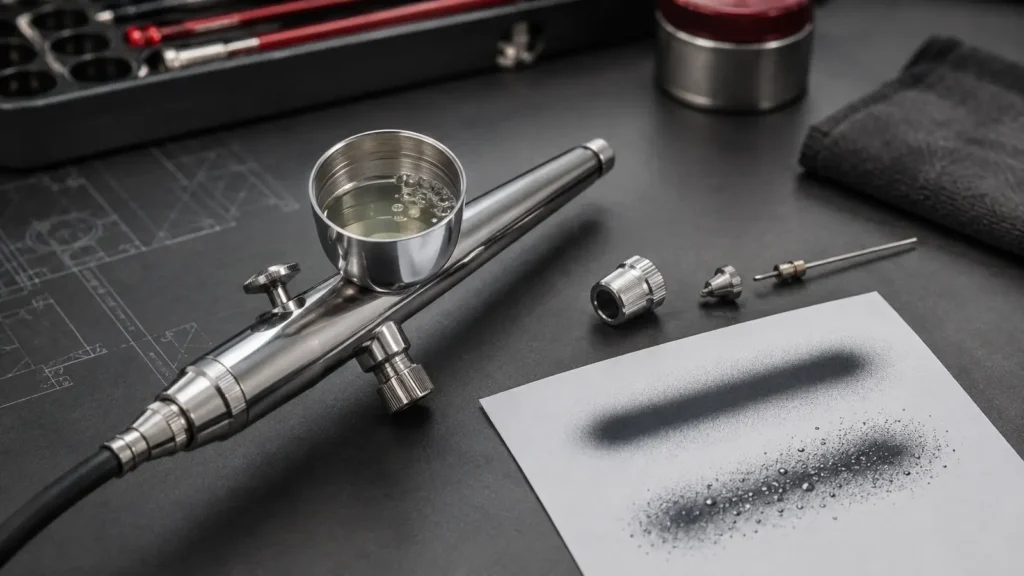
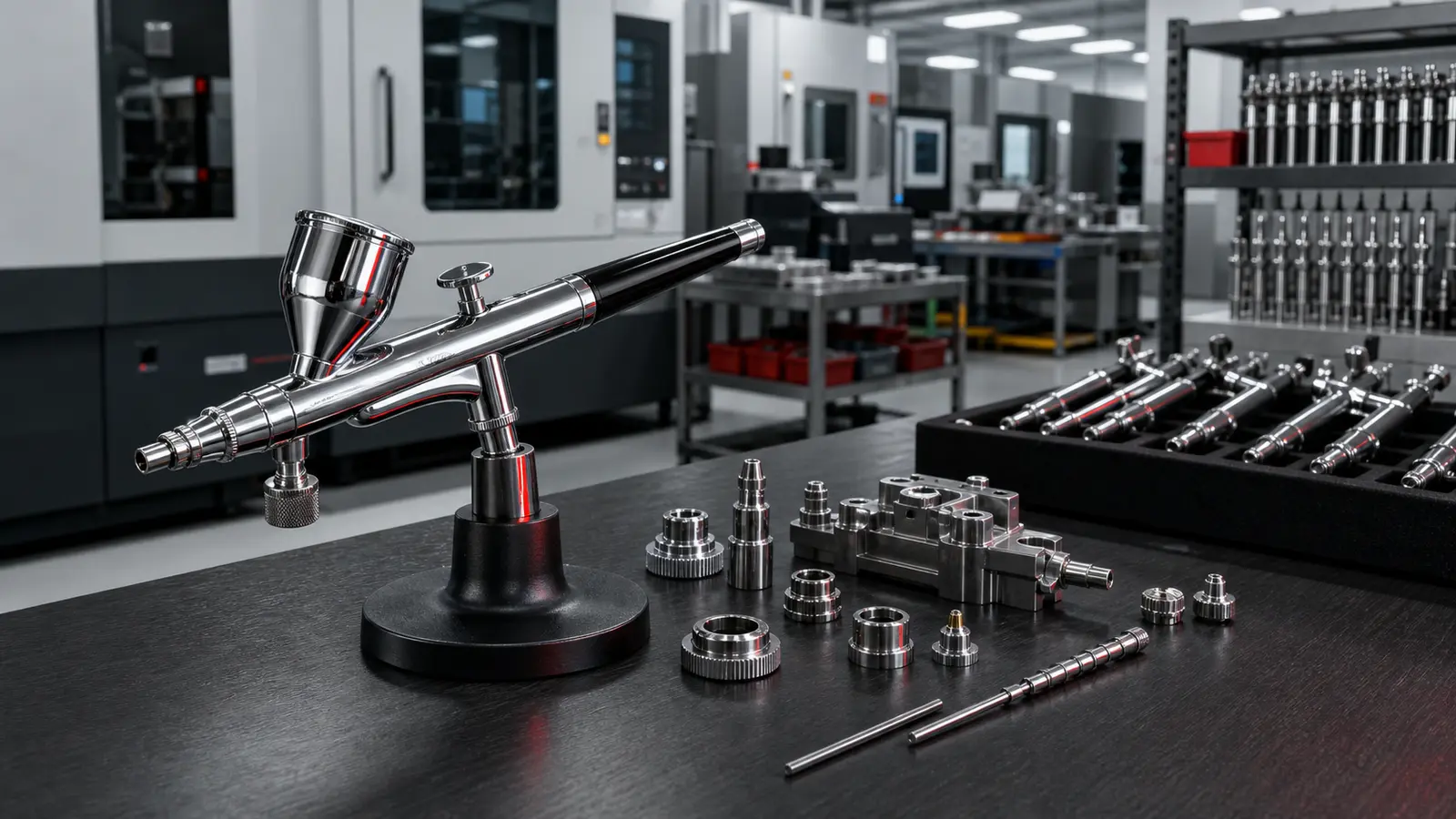
A search for a China airbrush manufacturer produces many similar catalogs, factory claims and quotations. The difficult part is not finding a supplier. It is proving that the supplier can hold the approved spray result, component fit, finish and package through the first order and every repeat order.
This guide is written for importers, distributors and private-label brands comparing an OEM airbrush factory. It turns a general supplier review into a product-specific audit: what to request, what to test and what to lock before a purchase order is released.
Factory size, certificates, product count and export markets are useful screening signals. They do not replace a matched sample, an inspection standard, a confirmed packing list or traceable revision control. Evaluate the exact SKU you plan to buy.
1. Start with a one-page buyer brief
An airbrush manufacturer in China cannot quote a meaningful OEM program from a product photo alone. The same chrome body can be supplied with different nozzle sizes, cups, fittings, finishes, accessory sets and inspection levels. Begin with the job the finished product must do and the channel in which it will be sold.
| Decision | Information to provide | Why it changes the quote |
|---|---|---|
| Application | Model painting, nail art, cake decoration, beauty, body art, touch-up or general hobby | Changes nozzle, cup, airflow and cleaning needs |
| User level | Starter, regular user or professional | Changes control feel, accessories and instructions |
| Sales channel | Distributor, retail shelf, marketplace, studio supply or kit program | Changes packaging, barcode and spare-parts plan |
| Market | Destination country, voltage, plug, language and required documents | Changes compressor and labeling configuration |
| Volume | Sample quantity, launch order and forecast repeat order | Separates standard-platform options from custom production |
For example, a 0.2 mm detail airbrush sold to experienced model painters needs a different validation plan from a 0.5 mm cake-decorating kit sold to beginners. A useful brief prevents the lowest unit price from pushing the project toward the wrong platform.
2. Verify that you are auditing the actual factory
The words manufacturer, factory and supplier are often used together online. The commercial model matters less than transparency, but buyers should know who controls engineering, machining, assembly, inspection and corrective action. Ask for evidence tied to the facility that will make your order.
- Request a live or recorded walkthrough from material receiving to packing, with the date and production area identified.
- Ask which airbrush components are machined in-house and which are purchased or subcontracted.
- Ask who owns the drawing revision, inspection record and approved sample after development.
- Confirm the legal company name on the quotation, invoice, bank details and export documents.
- Choose one proposed SKU and ask the contact to explain its complete process instead of giving a general company presentation.
A direct factory should be able to move from a product question to a process answer. A trading partner can still be useful, but the buyer needs a clear route to technical decisions and nonconformance handling.
3. Match machining capability to airbrush risk
Airbrush performance depends on the relationship between the needle, nozzle, air cap, trigger, valve and internal passages. A list of CNC machines has value only when the factory can show which parts they make, which dimensions they control and how measuring results connect to production adjustment.
The current YIDIAN factory profile documents a 3,000 m2 facility with more than 60 CNC machines. Its production material lists 15 six-axis precision compound turning machines and 10 multi-axis compound turning machines, both with stated processing accuracy up to 0.005 mm for applicable operations. Those figures are a starting point for an audit, not a substitute for checking the proposed part and tolerance.
Ask the OEM airbrush manufacturer to show three connected items: the drawing characteristic, the measuring method and the response when the result moves out of tolerance. This is more useful than asking whether the equipment is “advanced.” It also reveals whether engineering and production use the same revision.
4. Turn samples into a controlled comparison
A single attractive sample can hide unit-to-unit variation. Request enough samples to compare trigger feel, fit and spray behavior, and test every supplier under the same conditions. Record the liquid, thinning ratio, pressure, compressor, hose and operator. Without that record, a later production sample cannot be compared fairly.
| Sample checkpoint | What to record | Reject or investigate when |
|---|---|---|
| Air control | Trigger movement, return and valve response | Units feel materially different or fail to return cleanly |
| Material control | Start point, line response and repeatable gradient | Flow starts late, pulses or changes between units |
| Atomization | Pattern at agreed pressure and working distance | Pattern is off-center, unstable or inconsistent |
| Leakage | Air and material leakage at joints and seals | Any leak appears during the agreed test |
| Serviceability | Cleaning, disassembly, reassembly and part identification | Parts bind, markings are unclear or replacement fit is uncertain |
| Presentation | Finish, logo, included parts and packed condition | Appearance or component count differs from the approved brief |
Photograph the approved configuration and give it a revision number. Keep one reference with the buyer and one with the factory. The approved sample should be linked to a specification sheet, bill of materials, artwork set and packing list.
5. Validate the airbrush and compressor as one system
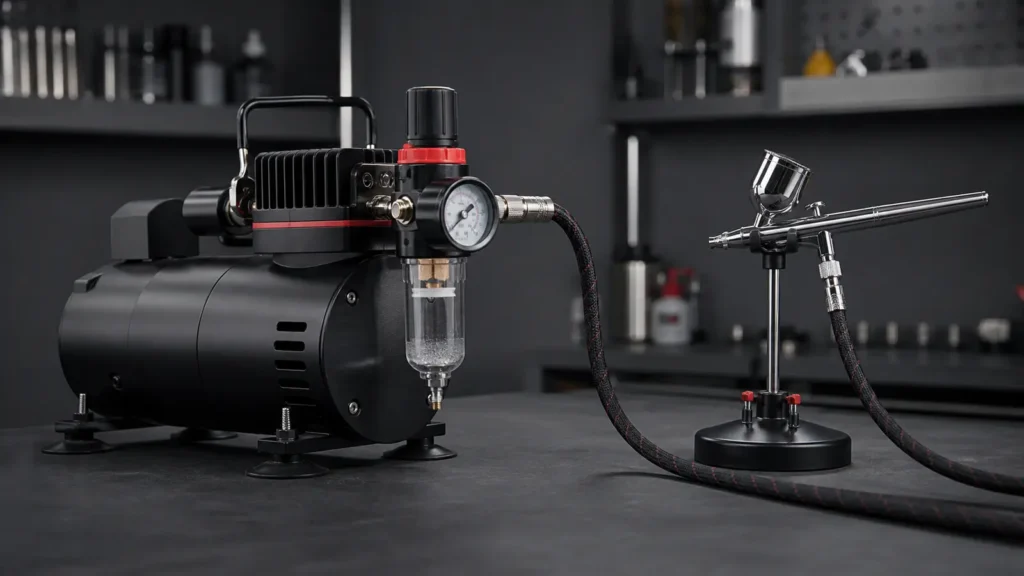
For a complete kit, do not approve the airbrush and compressor separately. Nozzle size, material viscosity, pressure, airflow, hose restriction, adapter and duty cycle affect the user experience together. A portable beauty kit and a tank compressor for longer studio sessions should not share the same acceptance assumptions.
Use real models to make the discussion concrete. The YD130 gravity-feed airbrush is available in 0.2, 0.3 and 0.5 mm configurations. The TC-20T compressor product record lists 23-25 L/min airflow, 6.5 bar / 95 PSI maximum pressure, a 3.0 L tank and several voltage configurations. A buyer should still test the selected YD130 nozzle, material and TC-20T pressure setting as the exact final kit.
Ask for fitting threads, hose length, regulator arrangement, plug type and label version in writing. Small compatibility errors create a disproportionate number of returns because the customer cannot begin using the product.
6. Separate OEM, ODM and private-label scope
Competitor pages often use OEM and ODM as broad promises. Put the requested level into the quotation so that every supplier prices the same work.
An OEM/ODM airbrush manufacturer should identify which decisions use an existing platform and which require engineering, tooling or validation. That distinction controls cost, timing and ownership more clearly than the marketing label.
| Project level | Typical scope | Buyer approval needed |
|---|---|---|
| Standard wholesale | Existing model, standard finish and standard package | SKU, nozzle, quantity and shipping terms |
| Private label | Logo, product color, box, insert, manual and barcode | Physical marking sample and complete packed sample |
| Configured OEM | Platform plus selected nozzle, cup, accessories, compressor and packaging | Matched system test and locked bill of materials |
| ODM development | Structural or user-experience changes with engineering work | Drawing, tooling, prototype, validation and ownership agreement |
The YIDIAN OEM/ODM program covers standard-platform configuration, color, logo, retail packaging, accessories and deeper development review. The exact scope, minimums and timing depend on the selected model and customization, so they should be confirmed after the buyer brief is complete.
7. Audit packaging with real carton data
Packaging is both brand presentation and a logistics specification. Ask for unit weight, pieces per carton, gross weight and carton dimensions before comparing landed cost. A printed box image without an outer-carton plan is not production-ready.
The YD130 product record provides a useful example of why package choices must be priced separately:
| YD130 option | Unit package | Quantity / carton | Gross weight | Carton size |
|---|---|---|---|---|
| Single airbrush | Bubble wrap | 100 pcs | Confirm with quote | Confirm with quote |
| PP box pack | PP box, 200 g | 50 pcs | 13 kg | 55.5 x 42 x 24.5 cm |
| Small black box pack | Small black box, 230 g | 50 pcs | 10.5 kg | 55.5 x 42 x 24.5 cm |
These are standard product-record values. A private-label insert, manual, accessory bundle or carton-mark requirement can change the final data. Reconfirm the packed sample and logistics sheet before shipment booking.
8. Define quality control for the exact SKU
Certificates can support a supplier review, but they do not specify how your airbrush is checked. Build a short control plan that follows the product from incoming components to final carton. It should identify the characteristic, method, frequency, acceptance rule and record owner.
- Incoming: critical material or purchased-component identity and condition.
- Machining: drawing-controlled dimensions for nozzle, needle and mating parts.
- Assembly: trigger movement, valve function, part fit and cleanliness.
- Performance: airflow, leakage, atomization and agreed spray check.
- Appearance: finish, color, logo position and acceptable cosmetic limits.
- Packing: SKU, component count, manual, barcode, carton mark and quantity.
Before the first order, also agree on what happens when a defect is found: containment, evidence, root-cause response, replacement or credit, and how the correction is verified. Repeat-order stability is a process, not a promise.
9. Use a weighted factory scorecard
A scorecard keeps price from hiding technical risk. Weight each category before quotations arrive, then require evidence for every score.
| Category | Suggested weight | Evidence |
|---|---|---|
| Product and application fit | 20 | Configuration rationale and matched test |
| Manufacturing control | 20 | Process route, equipment and measurement example |
| Sample consistency | 20 | Recorded comparison of multiple units |
| Quality and corrective action | 15 | SKU control plan and response process |
| OEM/ODM execution | 10 | Revision, artwork and golden-sample control |
| Packaging and logistics | 10 | Packed sample and carton data |
| Commercial clarity | 5 | Complete scope, terms and identified one-time costs |
A supplier with a lower piece price may create higher inspection, return or rework costs. The scorecard does not remove judgment; it makes the tradeoff visible.
10. Send an RFQ that can be answered properly
RFQ subject: OEM airbrush project – application, market and estimated quantity
Include: target application; user level; preferred feed and control type; nozzle range; material and pressure; compressor or kit requirement; destination market; voltage and plug; launch and repeat quantity; logo, color and packaging scope; required sample date; target shipment date; and any inspection or document requirement.
Ask every shortlisted airbrush wholesale supplier to quote the same configuration and identify exclusions. The first response should narrow the technical platform, test plan and packaging scope before it narrows the price.
Airbrush factory audit documents: connect the claim to the sample
An airbrush factory audit checklist works best when it connects supplier capability with the exact product under review. Ask for a sample configuration reference, a component list, the proposed inspection scope and the method used to retain test observations. A generic company presentation cannot establish that a particular needle, nozzle or complete kit passed the buyer’s agreed test.
Use the airbrush quality control checklist to define sample acceptance, spray-test evidence and the handling of failed results. For spare-parts planning, ask the supplier to populate a model-specific needle and nozzle matrix. This gives the importer an auditable link between the purchase order, approved sample and future service stock.
Build an evidence register before the supplier decision
Keep airbrush supplier audit evidence in one decision register instead of scattering screenshots, quotations and sample notes across inboxes. Each row should name the question, the exact file or sample that answers it, its revision, who reviewed it and what remains open. A document received is not automatically a requirement satisfied.
| Decision record | Minimum evidence | Release question |
|---|---|---|
| Factory identity | Legal entity, facility address and named commercial contact | Are the quotation and production site tied to the same supplier? |
| Process capability | Relevant equipment, controlled drawing or method, and a part-specific example | Does the evidence apply to the proposed airbrush rather than a generic capability? |
| Sample configuration | Model, revision, needle/nozzle/head set, compressor and packaging list | Can every reviewed sample be reconstructed from the record? |
| Quality release | Agreed check, observed result, reviewer, date and unresolved deviations | Was the decision based on recorded evidence rather than a sales description? |
An airbrush factory capability checklist should therefore link a claimed process to a component or risk in the planned SKU. Use the documented factory profile to form questions, the certificate section to identify documents that need scope and validity checks, and the sample checklist to capture actual observations. None of those sources replaces inspection of the proposed configuration.
Complete OEM airbrush supplier verification before comparing final commercial offers. The resulting airbrush RFQ document checklist can travel with the brief, normalized quotation, sample record and open-issue list. Buyers can assemble those inputs in the OEM buyer-brief builder and send only a reviewed version when they are ready for a product-specific reply.
Connect sample approval to corrective action
An airbrush supplier corrective action workflow should be agreed before the pilot order, not after a complaint appears. Define who can stop shipment, which evidence must be retained, how the cause is investigated and which sample or lot must be retested before release.
| Issue type | Evidence to request | Decision to record |
|---|---|---|
| Spray inconsistency | Sample ID, spray card, material, pressure under flow and changed components. | Retest after cleaning, adjust setup, replace part or hold stock. |
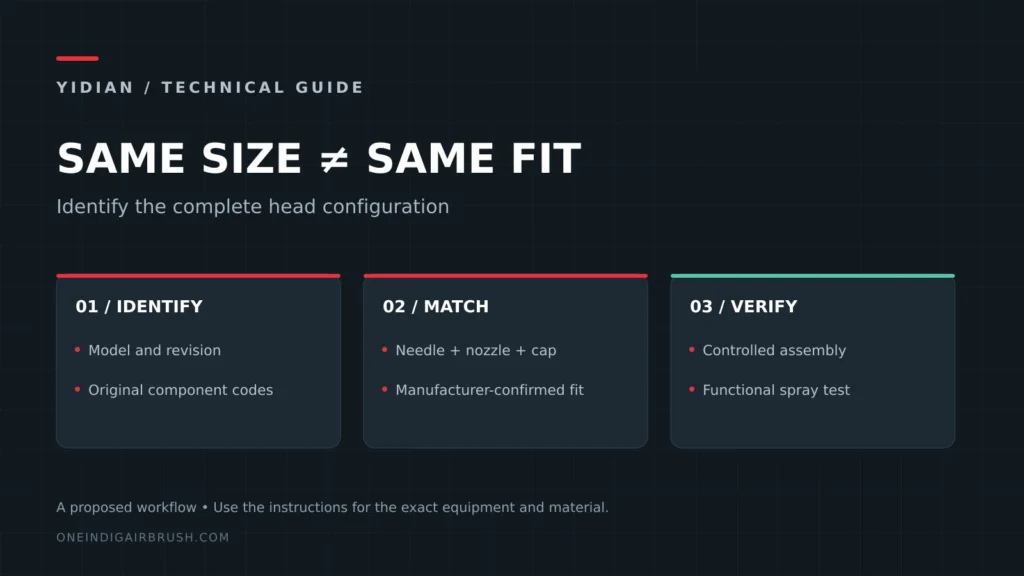
| Component mismatch | Needle, nozzle, cap and seal codes compared with the approved BOM. | Use current stock, rework, relabel or request a new sample approval. |
| Packaging deviation | Artwork revision, insert layout, packed sample and carton record. | Accept conditionally, correct before shipment or revise the package file. |
Airbrush batch traceability record does not need to be complicated, but it must connect the purchase order, production date or lot, approved sample revision, inspection record and shipment. Without that link, a supplier cannot reliably separate a one-off defect from a process change that affects repeat orders.
Frequently asked sourcing questions
How do I find a reliable airbrush manufacturer in China?
Use search results to create a shortlist, then verify the legal company, production facility, process ownership and exact SKU. Compare multiple samples under one written test plan and audit packaging, quality records and repeat-order controls before committing volume.
What is the difference between an OEM airbrush manufacturer and an ODM manufacturer?
OEM commonly means producing or configuring a product to the buyer’s defined requirements. ODM includes more design or development responsibility from the supplier. In practice, write the expected engineering, tooling, testing, ownership and approval tasks into the project scope instead of relying on the label.
What should be approved before an OEM airbrush order?
Approve the model, nozzle and cup, finish, logo, accessories, matched compressor setup, performance criteria, bill of materials, packed sample, artwork, manual, barcode, carton mark and logistics data. Give every item a revision or date.
Should I choose the lowest factory quotation?
Only after confirming that quotations cover the same specification, inspection, packaging and terms. A lower price for a different nozzle, accessory set, testing level or carton is not a valid comparison.
YIDIAN is a China airbrush manufacturer in Huizhou, Guangdong, producing airbrushes, mini compressors, accessories and complete kits for B2B buyers. To start a product-specific review, send the application, market, quantity and customization scope. The team can respond with a suitable platform and the data still needed for sampling.