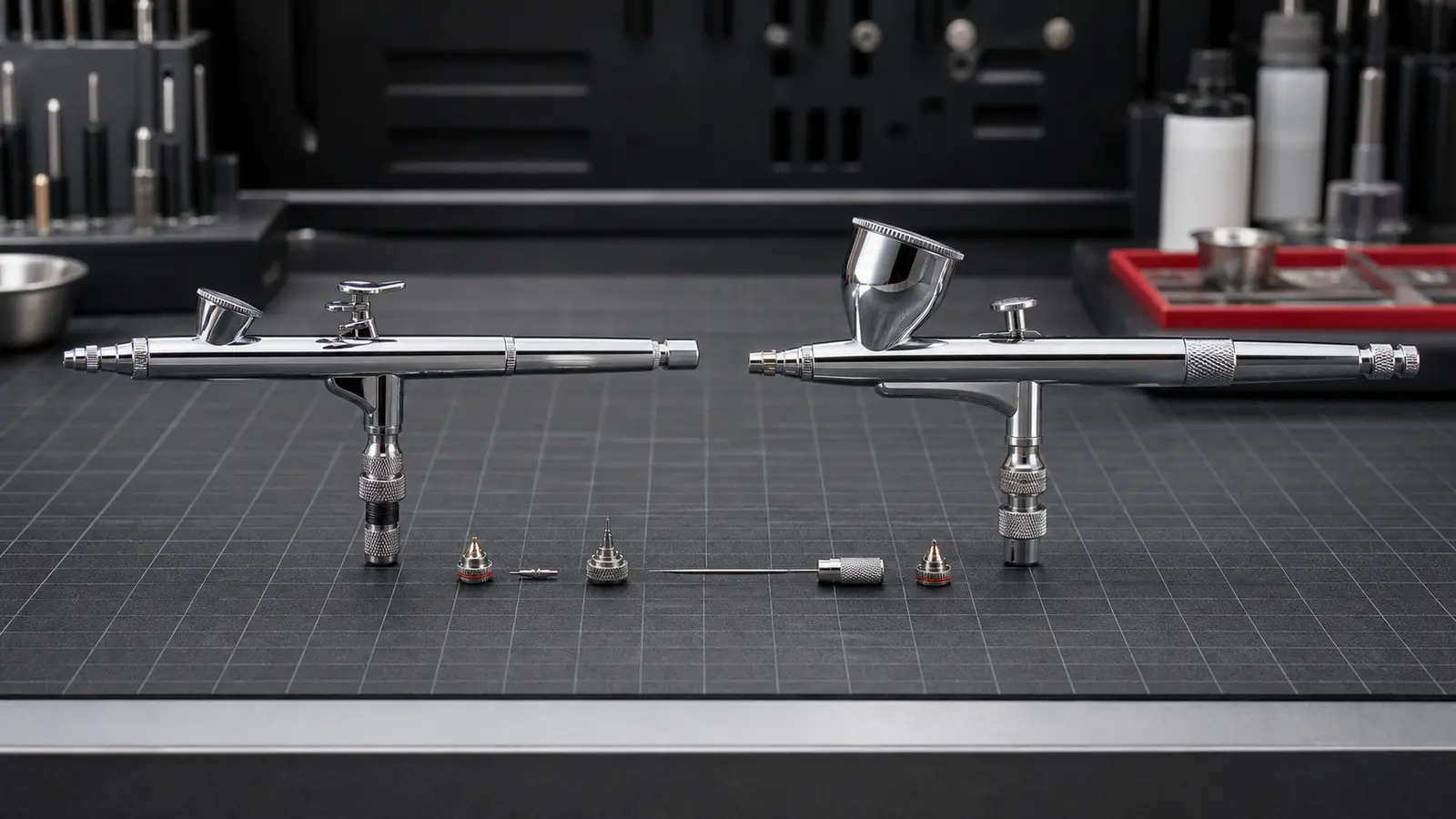
The choice between a single action and dual action airbrush changes how the user controls paint, how quickly they learn and which applications the product can serve. For a distributor or private-label brand, it also affects assortment strategy, accessories, instructions and support.
This guide explains the practical difference and shows how to discuss the decision with a dual action airbrush manufacturer.
How the two control systems work
A single action airbrush links the trigger primarily to airflow. Paint flow is normally set separately, so pressing the control starts the spray at a preselected material level. The operation is simple and repeatable, which can be helpful for broad coating, basic stenciling and users who value quick setup.
A dual action airbrush separates air and paint control in one trigger. Pressing down controls air; pulling back progressively increases material flow. This lets the operator move from a fine line to a broader gradient without stopping to adjust the tool. The extra control creates more creative range, but it requires more coordination and practice.
| Decision point | Single action | Dual action |
|---|---|---|
| Learning curve | Faster initial setup | More practice, more control |
| Paint control | Preset separately | Variable at the trigger |
| Fine detail | Limited compared with dual action | Strong when nozzle and pressure match |
| Repeat coverage | Simple and consistent | Depends more on operator movement |
| Typical positioning | Entry, utility and repetitive work | Hobby, art, beauty and professional ranges |
Why dual action dominates many creative markets
Model painters, illustrators, nail artists and other detail-focused users often prefer dual action because the trigger can shape a stroke while the airbrush is moving. That control supports dots, lines, fades, shading and transitions without repeatedly changing a separate material setting.
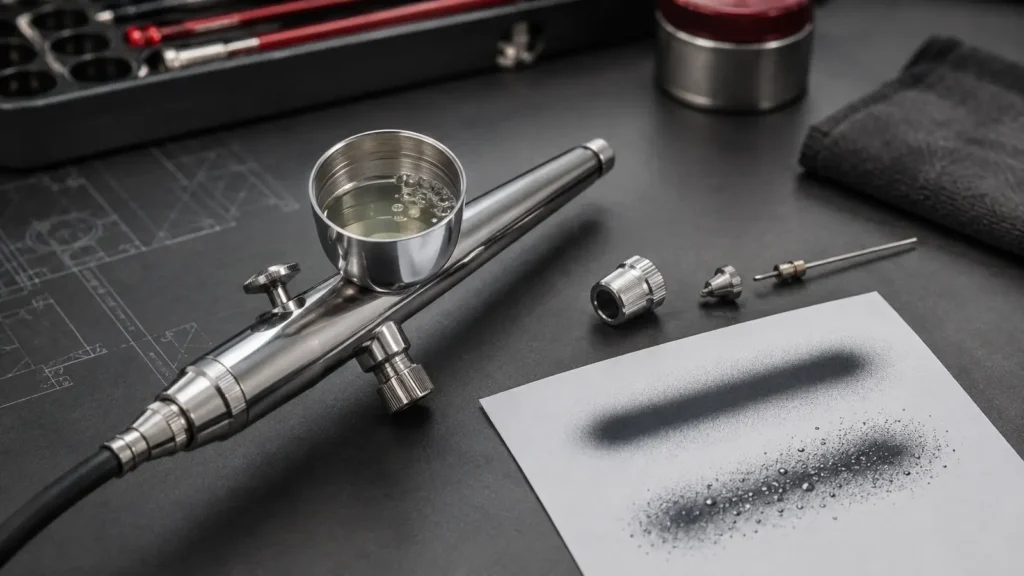
However, “dual action” alone does not guarantee a good user experience. Trigger geometry, spring force, needle alignment, nozzle quality and surface finish all influence control. When comparing samples from a dual action airbrush manufacturer, test the entire movement from first air to increasing paint flow. Look for a predictable response rather than an abrupt jump.
Feed style matters as much as trigger style
Many dual action models use gravity feed, with a cup mounted above the body. Gravity helps move material toward the nozzle and can support lower operating pressure and small paint volumes. This is common for fine detail and frequent color changes.
Siphon or side-feed systems serve different workflows. A siphon bottle can hold more material and swap quickly during larger jobs, while side-feed arrangements may improve the sightline in specialized work. The control type and feed type should be selected together, not treated as separate marketing labels.
Match nozzle size to the real material
A smaller nozzle can support fine lines, but it also places greater demands on paint preparation, cleanliness and operator technique. A 0.2 or 0.3 mm setup is a common starting point for fine-detail work. A 0.3 or 0.5 mm configuration can be more forgiving for general hobby, beauty and decorative use. Wider options may be considered for thicker materials and broader coverage.
Do not select the smallest number simply because it appears more professional. Ask the factory to test the intended material and pressure range. A stable 0.3 mm setup often creates a better customer experience than a very fine nozzle that clogs with the target coating.
Consider the user, not only the specification
A beginner kit can still use a dual action airbrush if the instructions, pressure setup and cleaning tools support the learning process. At the same time, a single action platform may be the better commercial choice for a simple, repeatable application where variable paint control offers little value.
Define the target user in practical terms:
- How much time will they spend learning?
- Do they need lines and gradients, or mainly even coverage?
- Will they change color frequently?
- What material viscosity will they use?
- Will the airbrush be sold alone or with a matched compressor?
- Does the market expect replacement needles and nozzles?
Beginner control path for model and miniature kits
The question behind single action vs dual action beginner airbrush is not which label sounds more advanced. It is how quickly the user can produce a repeatable result without damaging a precision part. A single-action unit can simplify broad coverage, while a dual-action unit gives a model painter more control once press-and-pull movement becomes familiar.
For a beginner dual action airbrush practice kit, approve the control system with a short exercise card: air-only hold, dot series, straight line, soft gradient and clean restart. If the tool jumps from no paint to too much paint, a new user may struggle even when the same airbrush looks good in expert hands.
The easiest airbrush for model beginners is usually the one with stable trigger response, clear pressure setup, compatible cleaning instructions and available needle/nozzle spares. Link the choice to the model painting setup guide and the complete kit checklist before approving a retail bundle.
Build a clear OEM assortment
For many brands, the strongest product line is not one universal model. It is a small progression that helps buyers understand the next step.
- Starter platform: robust setup, clear instructions and practical accessories.
- Core dual action model: balanced nozzle range, comfortable trigger and flexible packaging.
- Fine-detail option: tighter control and application-specific configuration.
- Complete system: airbrush, compressor, hose and maintenance tools tested together.
A capable OEM airbrush supplier should help separate meaningful product differences from cosmetic variations. Color and packaging support the brand, but nozzle range, trigger response, cup type and air supply create the actual use case.
How to evaluate a dual action sample
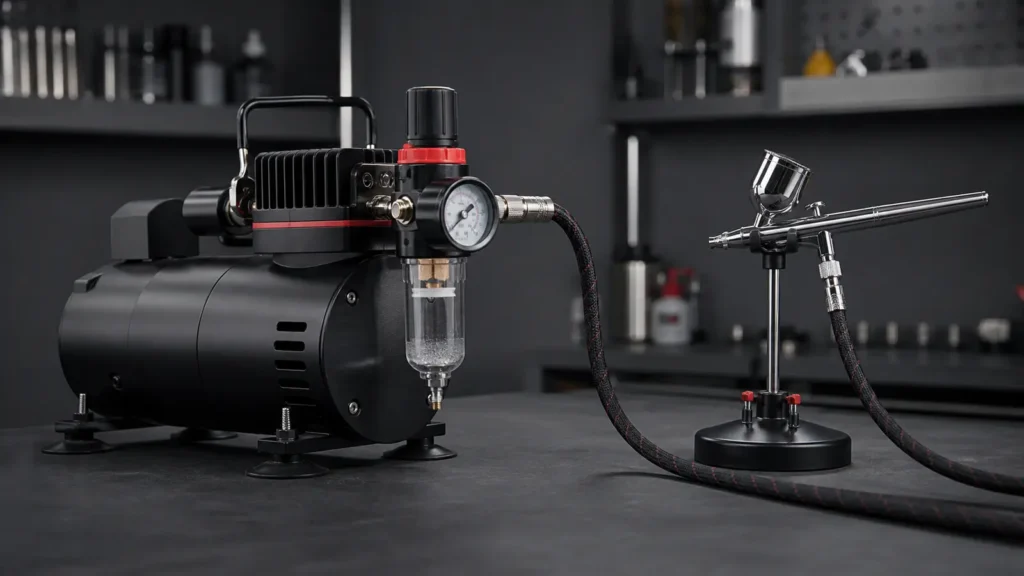
Connect the sample to the compressor planned for the final product. Test at several pressures with the target material. Begin with air only, then slowly pull back. The material should begin predictably and increase smoothly. Test dots, parallel lines, gradients and repeated starts.
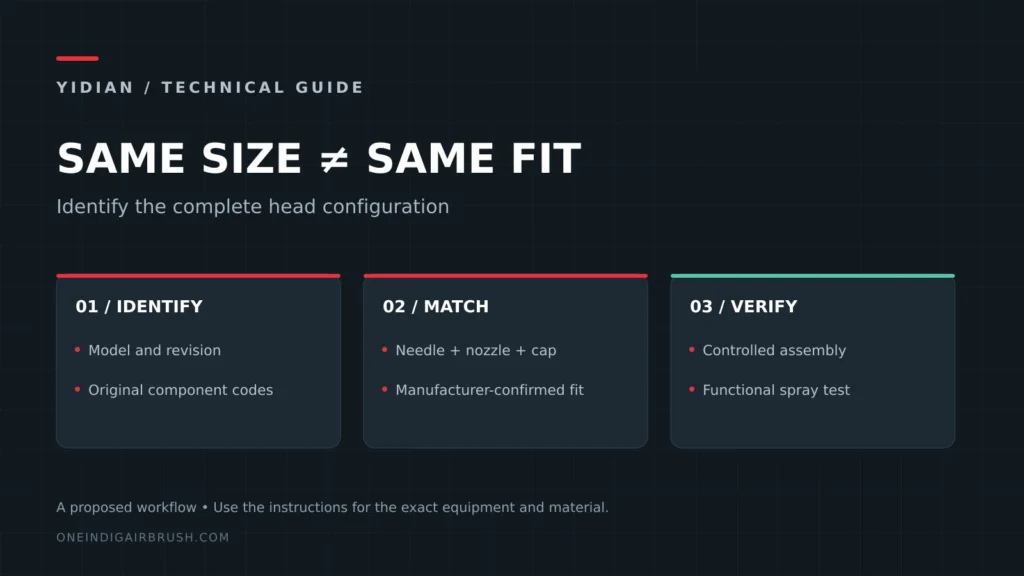
After spraying, inspect cleaning and reassembly. Remove the needle and nozzle components according to the instructions, then rebuild the tool and repeat the test. A product that performs only before its first cleaning will create after-sales problems.
Use the same paint, dilution, pressure, distance and test pattern for every sample. Record trigger feel, minimum stable line, gradient control, leakage, cleaning time and visible finish. A controlled test is more useful than a general impression.
Run a control test before approving the kit
A dual action trigger control test should be part of sample approval, not an informal bench impression. Use the same compressor, hose, nozzle size and material for each sample. Press for air, then pull back in small increments and record when paint first appears, whether the flow increases smoothly and whether the trigger returns without sticking.
For an airbrush trigger response sample, compare dots, short lines, a slow gradient and repeated stop-start movements. A trigger that jumps from dry air to too much paint may frustrate beginners even when the airbrush can make one good line in expert hands. This is where a single action airbrush beginner kit can still be a practical retail choice if the task is simple coverage or stencil work.
A dual action airbrush training kit needs a different approval path: include a practice card, a clear pressure setup, a cleaning routine and replacement-part identification. Link the sample decision to the airbrush quality control checklist and the needle and nozzle compatibility guide so the product remains supportable after the first sale.
Questions for a dual action airbrush manufacturer
- Which nozzle and needle combinations are standard for this platform?
- How is trigger response checked during assembly?
- Which seals are used, and what materials are they compatible with?
- Can color, plating, logo and package be customized?
- Are replacement needles, nozzles and caps available?
- Can the airbrush be tested with the intended mini compressor and hose?
- What is inspected on every unit before packing?
Which platform should you choose?
Choose single action when straightforward operation and repeat coverage are more important than variable line control. Choose dual action when the user needs to shape paint flow continuously, especially for detail, gradients and expressive work. Then validate the nozzle, feed style and air supply around the application.
YIDIAN develops dual action gravity feed platforms, complete kits and matching compressor systems for OEM and private-label programs. Share the target market, user level, application and expected price position to begin with a product configuration that can be tested, explained and repeated.