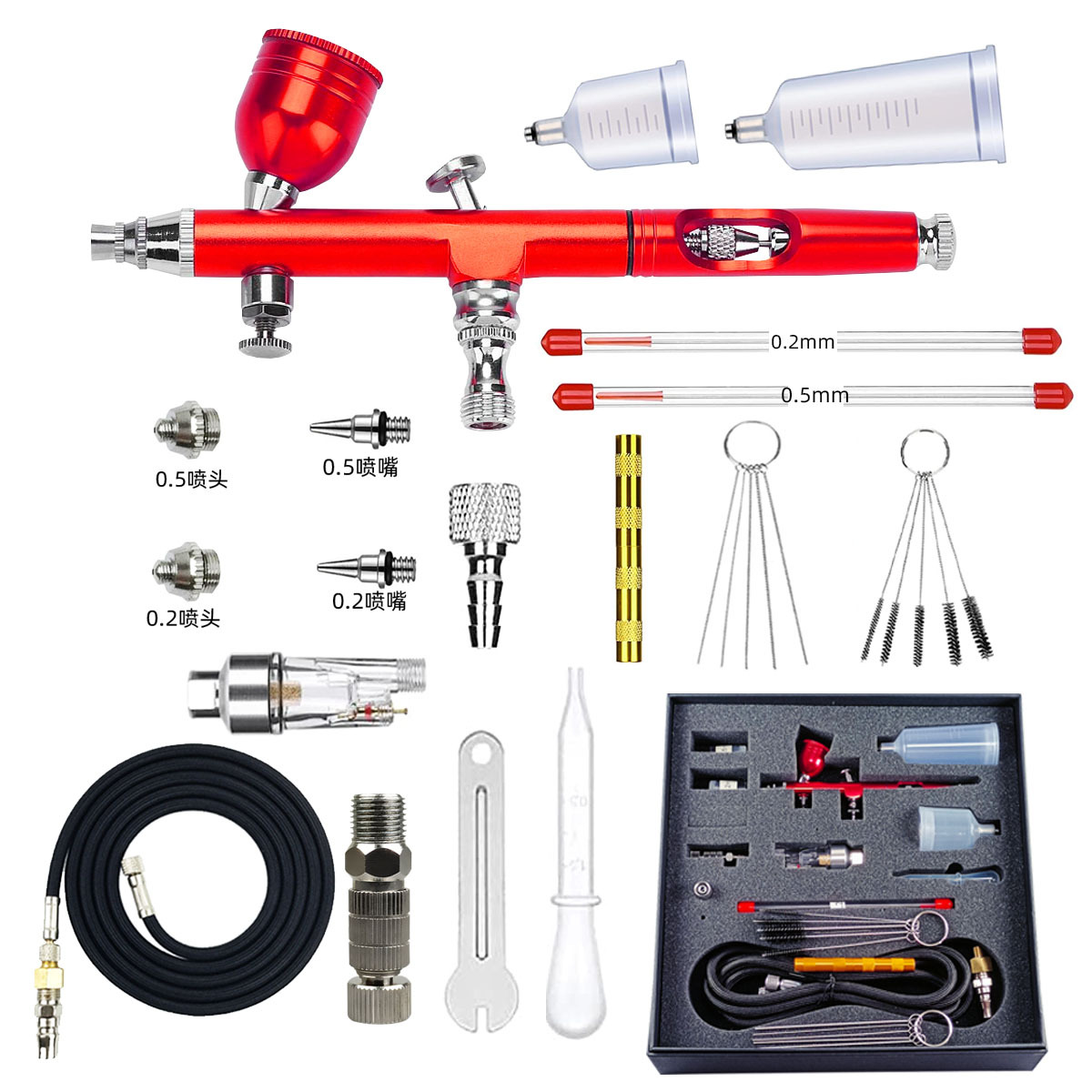
An airbrush nozzle size is not a promise of one exact line width. It is one part of a matched system that includes the needle taper, air cap, material viscosity, working pressure, spray distance and operator control.
This airbrush nozzle size guide compares common 0.2 mm, 0.3 mm and 0.5 mm configurations for distributors, private-label brands and users. The goal is to choose a setup that sprays the intended material reliably, not simply select the smallest number in a catalog.
What nozzle size changes in real use
The nozzle meters material around the needle tip and shapes the point where material meets moving air. A smaller opening can support lower material delivery and fine control, but it is also less tolerant of coarse pigment, dried paint and imperfect cleaning. A larger opening generally passes thicker material more easily and covers an area faster, although the final pattern still depends on the complete head design.
That is why two airbrushes marked 0.3 mm may not feel identical. Needle taper, nozzle length, cap geometry, trigger travel and paint passage all influence how quickly material begins to flow and how the spray expands as the trigger moves.
Choose the smallest nozzle that can spray the normal coating consistently through a full work session. A repeatable result is more useful than a single extra-fine line produced under ideal conditions.
Ask for an airbrush recommendationSend your question here
Tell YIDIAN what you need. You can start with a question; a company name, final quantity or finished specification is not required.
Quick comparison: 0.2 vs 0.3 vs 0.5 mm
| Nominal nozzle | Typical strength | Material tolerance | Best sample checks |
|---|---|---|---|
| 0.2 mm | Low material delivery, close detail, controlled fine shading | Needs well-mixed, appropriately reduced and often filtered material | Clean start, fine line stability, tip-dry behavior, restart after pause |
| 0.3 mm | Balanced detail and general coverage for mixed workloads | More forgiving across many properly prepared hobby and creative coatings | Dots, lines, gradient, small-area fill and color-change speed |
| 0.5 mm | Broader coverage and easier flow with suitable thicker material | Usually more tolerant, subject to coating and airbrush design | Atomization, wet edge, compressor recovery and overspray control |
These are practical directions, not universal limits. Always follow the airbrush and coating manufacturer’s recommendations, then verify the complete configuration with the actual material and air source.
When a 0.2 mm airbrush makes sense
A 0.2 mm airbrush can suit illustration, localized shading, fine model work and other tasks where low material delivery matters. The operator can work close to the surface and build narrow patterns when the paint is compatible and the needle tip is clean.
The tradeoff is preparation and maintenance. Large pigment particles, dried fragments or unsuitable viscosity can interrupt flow. A small deposit on the needle may distort the pattern before the nozzle becomes fully blocked. For a beginner product, a 0.2 mm configuration should be supplied only when the instructions clearly explain material preparation, pressure adjustment and safe cleaning.
If the pattern becomes coarse or intermittent, use the airbrush spitting troubleshooting sequence to separate tip-dry, viscosity, pressure, moisture and nozzle-sealing faults before changing nozzle size. When air visibly returns through the paint cup, use the separate nozzle backflow and cup-bubble guide.
What to verify on a 0.2 mm sample
- Paint begins smoothly after air without a sudden burst.
- Parallel lines remain centered and consistent at the intended distance.
- The airbrush restarts cleanly after a short pause.
- The needle and nozzle can be cleaned without excessive force or unusual tools.
- Replacement needle, nozzle and cap parts are clearly matched to the model.
Why 0.3 mm is a common all-round choice
A 0.3 mm airbrush often provides a practical balance between controlled detail and useful coverage. It can serve model painting, craft, nail art, illustration and general creative work when paired with a responsive dual-action trigger and stable air supply.
For a distributor building a small range, a balanced 0.3 mm gravity-feed platform can reduce assortment complexity. It gives users room to learn trigger control without requiring the most demanding paint preparation, while still supporting gradients, lines and small-area fill.
Do not assume every 0.3 mm platform is interchangeable. Test multiple production samples for trigger onset, centered spray, leakage, cleaning access and spare-part fit. The complete experience matters more than the nominal number.
Beginner miniature and Gunpla nozzle choice
For many hobby buyers, a 0.3 mm airbrush for miniatures is a practical first comparison point because it balances detail, cleaning tolerance and paint preparation. It can support primer, base color, shading and early line practice when the paint is reduced correctly and the air source is stable.
The best nozzle size for beginner airbrush use is not always the smallest diameter. A new Gunpla or miniature painter may get better results from a setup that restarts cleanly and tolerates normal hobby paint than from a fine nozzle that clogs during the first session. For an airbrush nozzle size for Gunpla decision, test primer or base color first, then evaluate fine shading after the user can repeat dots and lines.
Match the nozzle decision with the pressure guide, the model painting setup guide and the needle/nozzle compatibility record.
Where a 0.5 mm airbrush adds value
A 0.5 mm airbrush can be a better fit for primer, broader base coats, larger craft surfaces, tanning solutions or other approved materials that need more flow. The wider configuration may reduce the pressure or thinning compromises required to force a thicker coating through a fine setup.
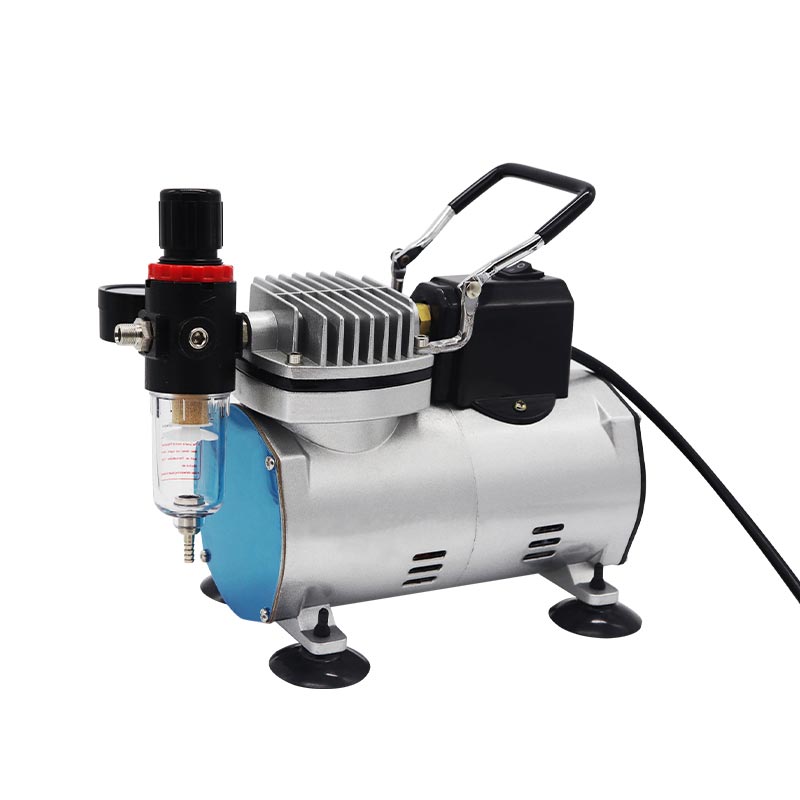
More flow also changes the air-system requirement. Test the final hose, regulator and compressor while spraying, not just while the trigger is closed. The air source must maintain useful working pressure throughout the expected pass. A compact compressor that supports fine intermittent work may recover differently during sustained 0.5 mm coverage.
Use our mini air compressor selection guide to compare airflow, duty cycle, regulation, moisture control and session length.
Match the nozzle to the coating
Application names alone are not enough. Two model paints or cosmetics can use different pigment, binder, solvent and viscosity systems. Start with the coating maker’s approved thinner, reduction guidance and safety information. Then test the prepared material through the proposed airbrush.
| Material observation | What it may mean | Controlled response |
|---|---|---|
| Flow stops after a few seconds | Tip dry, particles, excessive viscosity or front-end contamination | Inspect and clean first; adjust one preparation variable at a time |
| Pattern is dry and grainy | Material drying before the surface, excessive pressure or distance | Reduce distance or pressure in a small step and repeat the test |
| Paint spiders outward | Too much flow, excessive reduction or very close distance | Limit trigger travel and use lighter controlled passes |
| Broad coating takes too many passes | Nozzle and cup may be undersized for the job | Compare a wider matched setup under the same test conditions |
| Fine setup repeatedly clogs | Material and nozzle tolerance may be poorly matched | Verify filtration and cleaning, then test the next practical size |
Line width depends on more than diameter
Catalog images often imply that nozzle diameter directly determines line width. In practice, a fine line also requires a straight needle, centered nozzle, suitable taper, low and stable material delivery, correct pressure, close distance and a steady hand. Pull the trigger farther or increase distance and the same airbrush produces a wider pattern.
Compare complete systems by asking each sample to make the same five marks:
- Air-only hold: verify that no material appears before trigger pullback.
- Dot series: look for tails, bursts and delayed paint.
- Parallel lines: compare centering, width and density.
- Gradient: check whether material increases progressively.
- Filled area: inspect atomization, wet edge and coverage time.
Record the material, reduction, flowing pressure, distance, nozzle configuration and sample ID on every test card. This makes later supplier comparisons far more reliable.
Troubleshooting before sizing up the nozzle
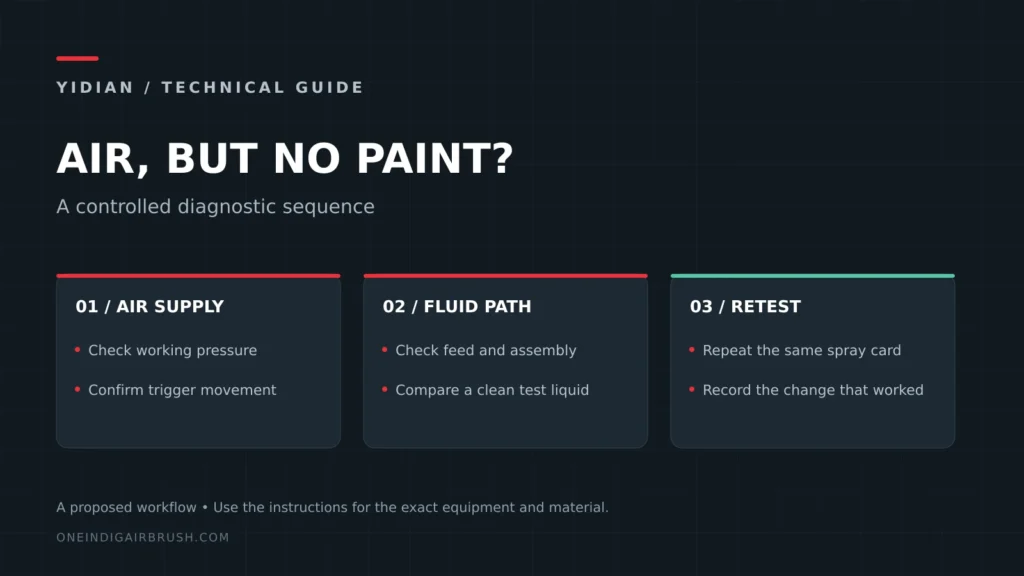
When to change airbrush nozzle size is a test decision, not a reaction to one blocked line. Confirm whether clean liquid sprays, whether the intended coating fails, whether tip dry appears after a pause and whether a wider matched head actually improves the same spray-card sequence.
An airbrush nozzle size troubleshooting chart should keep material, pressure, distance and cleaning level fixed while only the matched needle/nozzle/cap set changes. If several variables change together, the chart cannot show whether the larger size, better paint preparation or a cleaner front end solved the fault.
For a fine airbrush nozzle clogging retest, repeat the same dots, lines, fill and pause after cleaning and again after a compatible larger setup. If the original setup now passes with clean liquid but not paint, use the clogging service record before asking for a replacement or a new size package.
Use a sample matrix for private-label sourcing
An OEM buyer should not approve one display sample and assume all nozzle options perform the same. Request a controlled matrix with multiple bodies and the exact needle-nozzle-cap combinations being considered.
| Sample group | Purpose | Evidence to retain |
|---|---|---|
| Two or more units per selected size | Observe unit-to-unit consistency | Numbered test cards, photos and defect notes |
| Final coating or representative approved test medium | Confirm real material compatibility | Mix record, pressure, distance and session time |
| Replacement parts | Verify service fit and labeling | Part codes, package labels and installation check |
| Final hose and compressor | Approve the complete air system | Flowing pressure and recovery observations |
| Post-cleaning retest | Confirm performance returns after maintenance | Before-and-after cards using the same protocol |
For model applications, combine this matrix with the bench process in our airbrush for model painting guide. For a general platform review, see the gravity feed airbrush configuration guide.
Create the nozzle approval file for an airbrush series
An airbrush series nozzle selection brief should explain which head size belongs to each product position in the range. Keep the starter, detail, coverage and kit configurations separate, then record the material family, compressor pairing, cup or bottle style and support path for each one. This gives a buyer a reason to approve several nozzle options without turning the range into overlapping SKUs.
The airbrush nozzle sample approval record should retain the first card, post-cleaning repeat card, changed variables and any open deviation. If a 0.2 mm and 0.3 mm sample are compared, use the same paint preparation, pressure under flow, distance and trigger sequence. Otherwise the record only shows that the test setup changed.
A needle nozzle replacement parts handoff belongs beside the approval record. Link the approved nozzle size to the correct needle, cap, service label and replacement pack before the retail file is released. For repeat orders, connect this handoff to the needle and nozzle compatibility guide, the QC checklist and the parts buyer brief.
Connect nozzle choice to compressor and material evidence
An airbrush nozzle size sample matrix should list the tested head size, matched needle and cap, coating family, pressure under flow, distance, pattern task and cleaning retest result. This keeps a 0.2, 0.3 or 0.5 mm decision tied to the buyer’s actual use case instead of a catalog diameter alone.
A nozzle size material tolerance record should note how the same prepared material behaved after a pause, a restart and a short fill pass. If the larger nozzle only works because the pressure, thinner ratio or cleaning method changed, the record should say so rather than presenting the size as the only variable.
For starter kits, include a mini compressor nozzle demand check before approving the retail configuration. Compare flowing pressure, heat recovery and hose restriction with the selected nozzle and cup setup, then summarize the result in an airbrush nozzle size inquiry brief for the supplier when asking for samples or replacement parts.
Turn nozzle choice into an inquiry route
A request that only says “0.3 mm” leaves the tool model, coating, desired finish and replacement-parts scope unresolved. Use a model page to connect the application decision to an actual catalog configuration.
| Model | Published nozzle options | Confirm before ordering |
|---|---|---|
| YD130 | 0.2 / 0.3 / 0.5 mm; gravity feed and dual action. | The installed needle/nozzle configuration and any separately supplied head parts. |
| YD131 | 0.2 / 0.3 / 0.5 mm; dual action. | The selected size and contents of the chosen packaging configuration. |
| YD182 | 0.2–0.8 mm; gravity feed and dual action. | Available configuration for your coating; do not read the range as a promise that every size is supplied together. |
The listed alternatives are configuration information, not an automatic multi-size bundle. If the page offers one base product without a nozzle selector, confirm the installed size and included parts before adding it to your order. For a service replacement, use the model and parts identification guide instead of choosing by diameter alone.
Iwata’s airbrush FAQ explains that a head’s needle, nozzle and surrounding parts work together. That is a useful identification principle; it does not establish interchangeability between ONEINDIG models or brands. Keep the first spray card, pressure condition and post-cleaning result with your selected configuration.
Protect compatibility across replacement parts
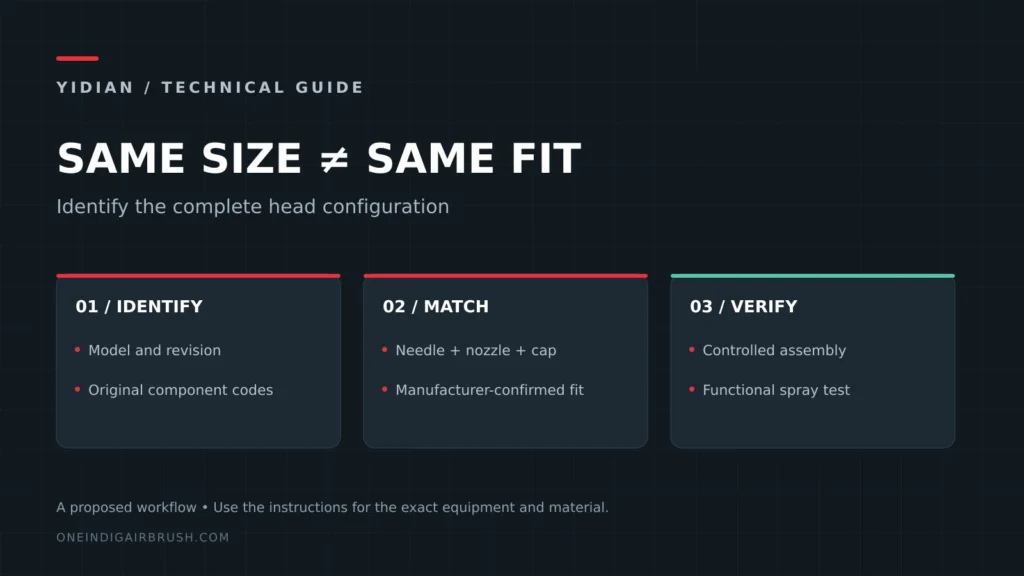
Needles, nozzles and caps should be treated as matched parts. Components with similar dimensions may use different tapers, seats, threads or air geometry. Mixing them can create leakage, poor centering or an unstable spray even when the parts physically assemble.
Private-label packaging should identify the model and nozzle size clearly on the product, replacement pack and instruction sheet. Keep approved part codes, drawings or controlled samples. If the supplier changes a component or sub-supplier, require a comparison test before the next production lot is accepted.
Common nozzle-size purchasing mistakes
- Choosing the finest diameter for beginners without testing normal paint preparation.
- Comparing nozzle numbers while ignoring needle taper, cap and trigger behavior.
- Using maximum compressor pressure instead of flowing working pressure.
- Approving one sample instead of checking consistency across several units.
- Including multiple nozzle sets without clear compatibility labels or service instructions.
- Assuming a larger accessory count creates a better complete kit.
- Failing to repeat the spray test after cleaning and reassembly.
Frequently asked questions
Is 0.2 mm or 0.3 mm better for detail?
A 0.2 mm setup can support lower material delivery and fine work, but a well-designed 0.3 mm airbrush may produce more reliable detail with the user’s normal paint. Compare both with the same material, pressure and test card.
Can a 0.5 mm airbrush still spray a narrow line?
It may produce a controlled narrower pattern with limited trigger travel and close distance, but it is generally selected for greater material flow and coverage. The actual result depends on the complete head design and operator.
Do I need three nozzle sizes in one kit?
Only if each size has a defined user job and the parts can be identified and changed safely. One balanced configuration with good instructions is often more useful than several poorly differentiated options.
Why does a fine nozzle clog after cleaning?
Possible causes include dried material remaining in the passage, a damaged or mis-seated nozzle, an incompatible needle-nozzle pair, debris introduced during assembly or unsuitable paint preparation. Inspect systematically rather than forcing a cleaning tool into the nozzle.
Airbrush needle replacement versus nozzle conversion
An airbrush needle replacement restores a known configuration; an airbrush nozzle conversion changes that configuration and may require a different needle, nozzle and cap or head. A 0.3 mm spare from an unrelated model is not automatically compatible with another 0.3 mm airbrush. Confirm the complete part references in the needle and nozzle compatibility guide.
If a size change leaves the airbrush unable to spray paint, record which parts changed and compare a compatible clean liquid with the intended coating. Check assembly and approved part matching before selecting yet another diameter. This keeps application testing separate from diagnosing an incorrectly assembled or incompatible head.
Choose a testable configuration
The best answer to 0.2 vs 0.3 vs 0.5 mm airbrush nozzle size is the configuration that meets the target finish with stable flow, manageable cleaning and available replacement parts. Define the coating and task first, then approve the complete airbrush, air source and maintenance process together.
YIDIAN develops dual-action gravity-feed airbrushes, nozzle options, mini compressors and private-label kits for global distributors. Review our airbrush product range or send your application, coating and nozzle requirements for a controlled sample plan.