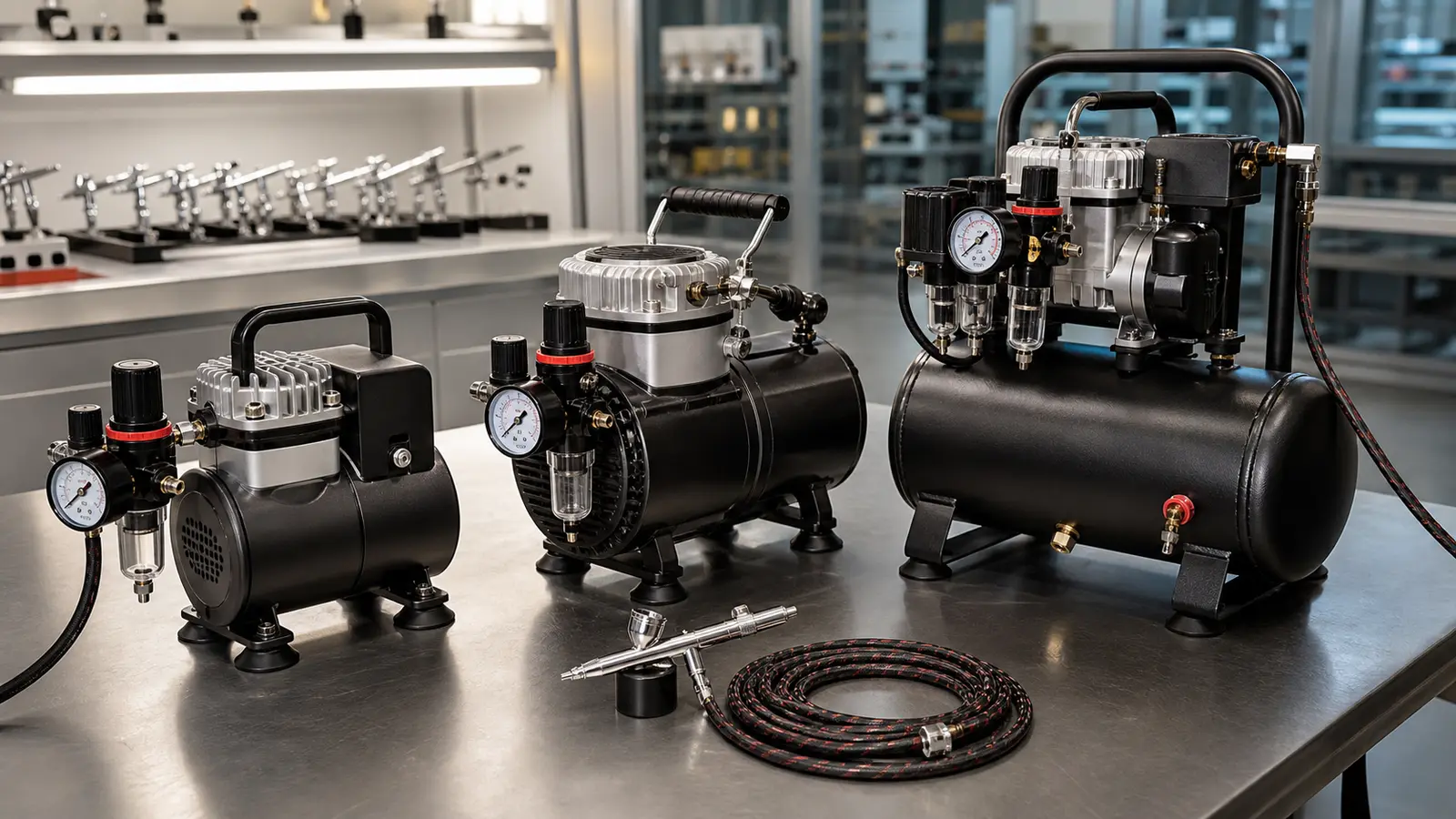
The compressor determines whether an airbrush receives stable, usable air. A product that looks compact may still be too noisy, too weak or poorly matched to the intended nozzle. The right choice begins with working pressure, airflow and duty cycle, then considers portability, tank size and controls.
This guide explains how to compare options with a mini air compressor manufacturer for hobby, beauty, nail art, model painting and professional airbrush systems.
Starter compressor checks for model and miniature kits
An airbrush compressor for beginners should be judged by the complete air path, not by maximum pressure alone. A new user needs a compressor, regulator or control mode, hose, fitting and airbrush combination that starts predictably, holds pressure while air is flowing and does not hide leaks or moisture problems behind a confusing gauge reading.
A mini compressor for miniature painting can work well when the session length, nozzle size and material are realistic for the unit. Test primer or base color on a card first, then run a short pause-and-restart check. If the pattern begins to fade, separate compressor recovery from paint clogging by using the miniature pressure check and the clogging triage.
For an airbrush compressor for Gunpla, document the exact airbrush, nozzle, hose, fitting and material used in the test. A compact unit that feels fine during a short air-only pass may still struggle through primer or a longer base coat. Pair the compressor note with the beginner kit checklist so the buyer can see whether the air source, cleaning items and spare parts support the same first-use workflow.
Maximum pressure is not working pressure
Compressor specifications often lead with a maximum PSI value, but users spray at a regulated pressure below that maximum. The useful question is whether the system can maintain the required pressure while air is flowing through the selected airbrush.
A portable unit may be suitable for low-pressure, intermittent work. A piston compressor with higher output can support longer sessions, larger nozzles or more demanding materials. Ask for pressure behavior under load, not only the shut-off number.
Use our airbrush pressure and PSI guide to set the regulator under airflow, choose a trial range and separate pressure faults from paint or nozzle problems.
Airflow must match the nozzle and application
Larger nozzle openings and higher working pressure require more airflow. If the compressor cannot keep up, pressure drops during a pass and atomization changes. This can appear as pulsing, uneven coverage or a pattern that becomes weaker over time.
Provide the airbrush model, nozzle range and intended material to the airbrush compressor supplier. The factory should test the planned combination rather than treating the compressor as an isolated product.
Feed style is part of that demand. The gravity feed vs siphon feed airbrush comparison explains why bottle pickup commonly needs more air support than a small top cup.
Run a compressor ripple test before blaming paint
An airbrush compressor ripple test compares air-only output, clean-liquid spray and prepared paint with the same regulator setting. If all three pulse, inspect the compressor cycle, regulator, hose, filter, quick coupling and leaks before changing paint. If only paint pulses, use the airbrush compressor pulse vs paint restriction branch to separate material preparation from air supply.
Understand duty cycle and session length
Some compact compressors are designed for short intermittent sessions. Others use larger motors, cooling or an air tank to support longer work. The correct choice depends on how users actually operate the system.
- Short beauty or nail sessions: portability and low noise may be more important than continuous high output.
- Model painting and hobby work: stable pressure and comfortable session length are important.
- Training, studio or touch-up work: a tank-equipped system may reduce cycling and improve airflow stability.
Ask how long the unit can operate under the expected load and how thermal protection behaves. Do not assume that a larger housing automatically means a longer duty cycle.
Portable, tankless and tank-equipped options
| Compressor type | Main strengths | Points to verify |
|---|---|---|
| Portable compact | Lightweight, easy storage, simple kits | Pressure stability, battery or power supply, session length |
| Tankless piston | Direct output, compact workshop footprint | Pulsing, heat, noise, automatic stop behavior |
| Tank-equipped piston | Smoother reserve air, reduced motor cycling | Size, weight, drain, safety and shipping cost |
A tank does not improve every kit. It adds weight and carton volume, but it can create a steadier professional experience. Select it when the application benefits enough to justify those tradeoffs.
Evaluate noise in the real environment
Noise expectations differ between a factory workshop and a beauty studio. Published decibel values are useful only when the test method and distance are understood. Listen for vibration, rattling and changes under load, not only the average sound level.
Rubber feet, housing design, motor balance and assembly quality influence perceived noise. Test the compressor on the kind of surface the customer will use. A quiet motor can still sound unpleasant if the case or table resonates.
Check pressure control and automatic operation
A regulator and gauge help users set repeatable pressure. Moisture filtration may also be important, especially in humid environments or longer sessions. Some compact systems use electronic pressure modes instead of a conventional regulator.
Verify how automatic stop and start work. The compressor should respond predictably when the trigger is released or pressure reaches its set point. Examine fittings for leakage because small leaks can cause unnecessary cycling.
Power configuration must match the destination
For global OEM projects, confirm voltage, frequency, plug type and power adapter requirements for every market. Labels, instructions and packaging must match the final electrical configuration. If one product family uses several adapters, create a clear SKU and carton identification process.
Ask the mini air compressor manufacturer which approvals or test documents are available for the exact configuration. Requirements vary by destination and sales channel, so final compliance should be reviewed for the target market.
Test the complete air path
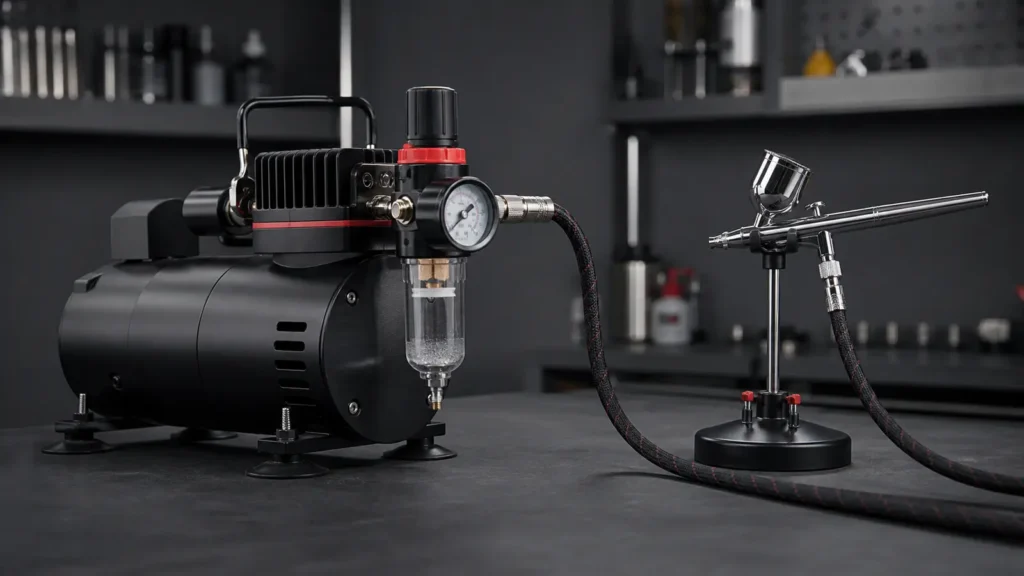
The compressor, regulator, moisture filter, hose, quick fitting and airbrush form one air path. Thread mismatch, narrow fittings or long small-diameter hoses can affect performance. Assemble the exact retail configuration and test it together.
Record pressure with the trigger closed and with air flowing. Spray repeated lines and a broad area for the expected session length. Watch for pressure drop, pulsing, heat, moisture, leakage and changes in sound.
Condensate control should be tested for the target climate, not only in a short factory check. Use the airbrush moisture trap and water-separator guide to review placement, draining, tank maintenance and point-of-use protection.
Match compressor tiers to product tiers
A clear assortment helps customers choose:
- Portable starter system: compact air source, simple pressure control and one practical airbrush.
- Core creative system: stronger output, stable regulation and a flexible dual action airbrush.
- Studio system: tank-equipped compressor, moisture management and accessories for longer sessions.
Use performance differences to define each tier. Cosmetic changes alone make the assortment difficult to explain.
Quality checks for an OEM mini compressor
Discuss inspection at component, assembly and finished-product stages. Relevant checks may include electrical safety, pressure response, leakage, gauge behavior, noise, vibration, automatic stop, heat and appearance. The exact plan depends on the compressor design and target market.
Packing must protect gauges, fittings, handles and tanks. A complete kit also needs a controlled component count so that hoses, adapters and airbrushes are not omitted.
Questions for a mini air compressor manufacturer
- What pressure and airflow can the unit maintain under load?
- Which airbrush nozzle sizes have been tested with it?
- What is the expected operating pattern or duty cycle?
- How are heat, noise and vibration controlled?
- Does the unit include regulation, moisture control and automatic stop?
- Which voltage, plug and adapter versions are available?
- Can housing color, marking and packaging be customized?
- What functional tests are completed before shipment?
Compare airbrush compressor airflow requirements on the same basis
Two airflow figures are not directly comparable unless their units, measurement method and delivery pressure are stated. Ask the supplier whether an output figure describes an unloaded condition or delivery at the intended working pressure. Leave an unanswered field blank rather than treating it as a confirmed specification.
For an airbrush compressor with tank vs tankless comparison, separate stored-air convenience from sustained delivery. A tank can supply a reserve between motor cycles; its presence alone does not prove that the compressor can support the chosen airbrush throughout the job. Likewise, airbrush compressor duty cycle must come from the exact model’s instructions, including the permitted run/rest pattern and operating conditions. Do not copy a competing model’s limits.
- Request the working-pressure airflow statement and its measurement conditions.
- Identify the airbrush head, hose, filter, fittings and number of tools operating together.
- Record the permitted session pattern, auto-stop behavior and unresolved evidence.
Our blank air-system comparison workbook puts those questions beside supplier A/B fields. It contains no measured results or approved ratings. Use the pressure-drop record for the sample check, then bring the completed requirements to the buyer brief.
Technical context: Iwata’s compressor selection guide. The comparison worksheet is YIDIAN’s proposed buyer record, not a manufacturer test report.
Run a repeatable compressor acceptance cycle
A useful sample review should reproduce the retail air path instead of testing a bare compressor. Fit the intended regulator, moisture trap, hose, adapters and airbrush; record the exact configuration; then adjust the regulator while the trigger is held for air. This makes the airbrush compressor working pressure test an observation under flow rather than a copy of the shut-off pressure printed on a listing.
| Acceptance check | Record | Decision boundary |
|---|---|---|
| Working pressure | Static gauge reading, reading with air flowing, airbrush and complete air path | Compare only samples tested with the same setup and method |
| Recovery | Starting condition, length of the controlled air draw and time to the next stable state | An airbrush compressor pressure recovery test is model- and setup-specific, not a universal pass time |
| Run/rest pattern | Permitted duty instructions, motor cycles, pauses and any protection event | Use an airbrush compressor run rest cycle checklist based on the exact manual |
| Sound | Room, surface, distance, operating state and any rattle or vibration | An airbrush compressor noise test for studio is comparable only when those conditions stay consistent |
Repeat the same sequence on more than one sample and keep unresolved fields open. Do not invent a duty cycle, sound rating or recovery limit when the supplier has not provided the test conditions. Iwata’s official compressor guidance distinguishes working pressure from maximum pressure and explains why noise, tank behavior and duty cycle must be considered with the intended use; its compressor manual also instructs users to set pressure while air is flowing.
Pair this record with the moisture-placement inspection and the complete-kit commissioning check. Together they show whether a result belongs to the compressor itself or to a filter, hose, adapter or connection elsewhere in the air path.
Method references: Iwata airbrush compressor selection guidance and the Iwata Studio Series compressor manual. Follow the instructions supplied with the exact equipment being evaluated.
Select by real use, then confirm with a sample
A mini compressor should be evaluated by the airbrush and workflow it supports. Pressure, airflow, session length, noise and portability must form one practical balance.
YIDIAN offers portable and professional compressor platforms for OEM and private-label airbrush systems. Share the nozzle range, application, working pressure, session length and target market so the sample can be tested as a complete airbrush kit rather than as an isolated machine.