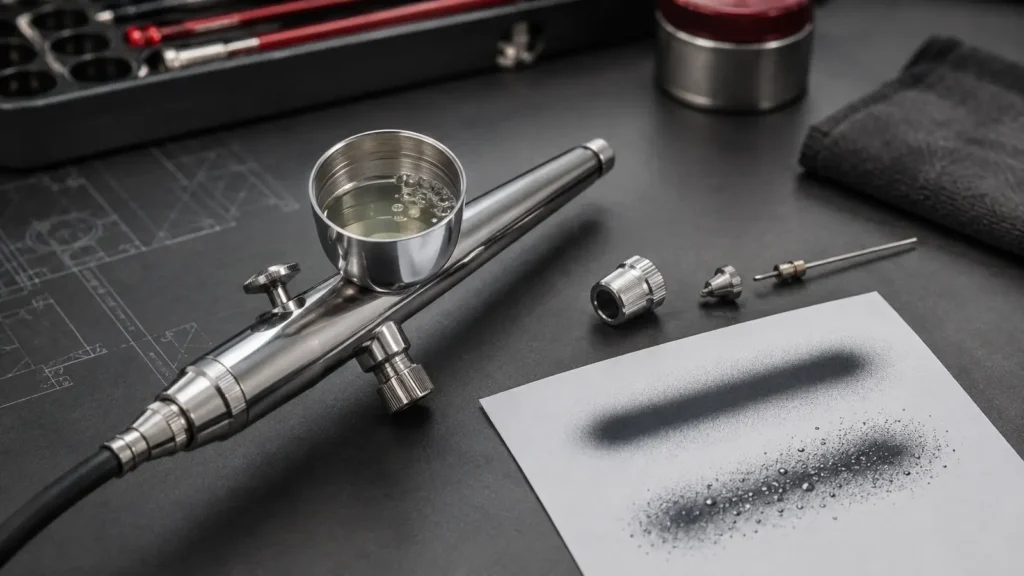
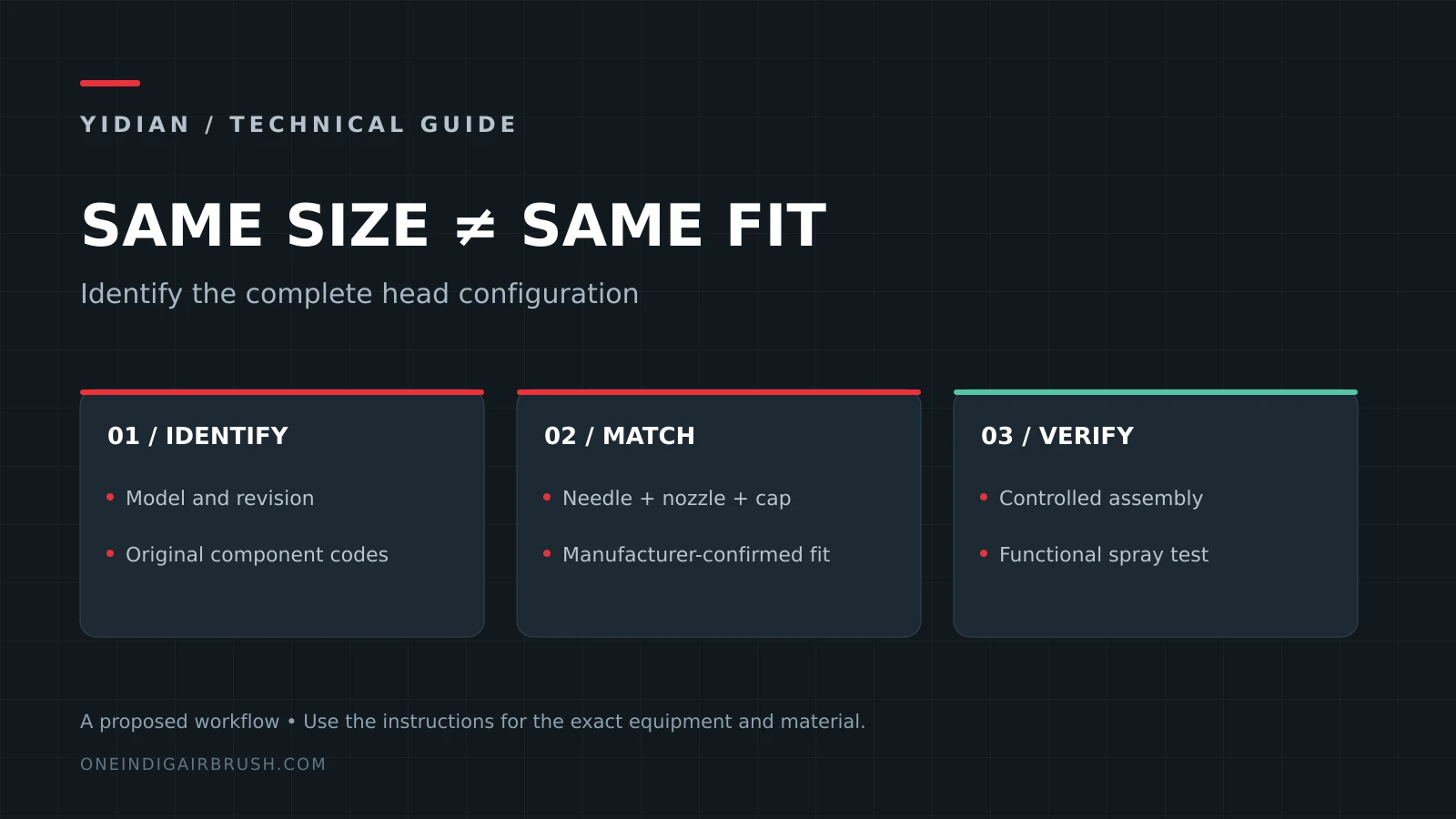
Airbrush needle and nozzle compatibility depends on the complete model and head configuration, not just a diameter such as 0.3 mm. A spare can look correct, enter the body or share a nominal size while still seating incorrectly or producing an unstable pattern. This guide helps buyers, distributors and service teams identify a replacement before ordering it.
Are airbrush needles and nozzles universal?
No. Treat a replacement as model-specific unless the equipment manufacturer or a documented compatibility list confirms otherwise. Relevant differences can include needle length and taper, nozzle mounting and seat, head geometry, cap clearance and the way the assembly closes the fluid path.
A nominal nozzle size is only one attribute. It does not identify the thread, the shoulder position or the relationship between the nozzle and the cap. Use the nozzle-size selection guide for application choice, then verify the exact part configuration separately.
The replacement-parts information to collect
| Identification item | Why it matters | What to provide |
|---|---|---|
| Brand, full model and revision | Similar names and older versions may use different parts. | Model marking, purchase reference and available revision information. |
| Needle part code | Length, taper and drive engagement affect operation. | Original packet code or an entry in the correct parts diagram. |
| Nozzle part code and mounting | A screw-in or compression-seat design needs the intended mating surface. | Model-specific exploded drawing and part number. |
| Nozzle/head size | Nominal diameter must agree with the supported configuration. | The complete head-size designation, not an estimated tip measurement. |
| Cap or head assembly | The surrounding air geometry can be part of the size conversion. | Required cap/head code from the manufacturer. |
| Coating and cleaning system | Material compatibility and maintenance affect service suitability. | Coating type and the specified cleaning product. |
Why the needle, nozzle and cap must work together
The needle controls the fluid opening by moving relative to the nozzle. The nozzle and surrounding head direct the interaction of liquid and air. A part mismatch may therefore change fluid shutoff, start behavior or the spray pattern even when the assembly can be physically installed.
Iwata’s FAQ provides a manufacturer-specific example: its advice for size changes calls for the correct needle, nozzle and nozzle cap for the model, and warns that conversion can affect warranty. Use that as a reason to consult the actual manufacturer’s configuration, not as proof that every brand shares Iwata parts or conversion options.
How to identify a spare without damaging the original
Start with the model marking and the official exploded diagram. Search by model and part code rather than only by a marketplace description. Photograph the original packaging, model label and accessible assembly if support staff need to identify it. Label the removed parts so components from two similar airbrushes do not become mixed on the bench.
Do not probe a precision nozzle opening with a drill, wire or an improvised measuring object to determine its size. Do not tighten an uncertain nozzle to see whether a thread will fit. A cross-threaded component creates a repair problem without answering the compatibility question.
If a part number cannot be established, ask the supplier for written confirmation against the exact model or a drawing reference. A photo can narrow the options, but should not be represented as conclusive evidence of an internal dimension or material specification.
Replacement and size conversion are different requests
A replacement aims to restore the approved configuration. A conversion changes the configuration and may require several components or may not be supported at all. Specify which request you are making. Replacing a damaged 0.3 mm head with a compatible 0.3 mm assembly is a different project from trying to convert it to 0.5 mm.
Before a conversion, obtain the supported parts list, installation instructions and any limitations from the manufacturer. Check whether the intended coating actually needs a different head or whether paint preparation, working pressure or technique is the more relevant variable. A nominally smaller nozzle is not an automatic guarantee of a finer usable line.
Symptoms that justify a compatibility check
A sudden fault after a parts change is a strong reason to review the changed configuration. Useful observations include paint leaking with the control closed, delayed pickup, an uneven pattern, unexpected restriction or cup bubbling. These observations do not prove a mismatch: contamination, a bent needle or a sealing defect can look similar.
Use the no-paint diagnostic guide when delivery stops and the backflow guide when air enters the cup. Keep the original and changed configuration documented so the service team knows what actually changed.
Check pulsing after nozzle replacement
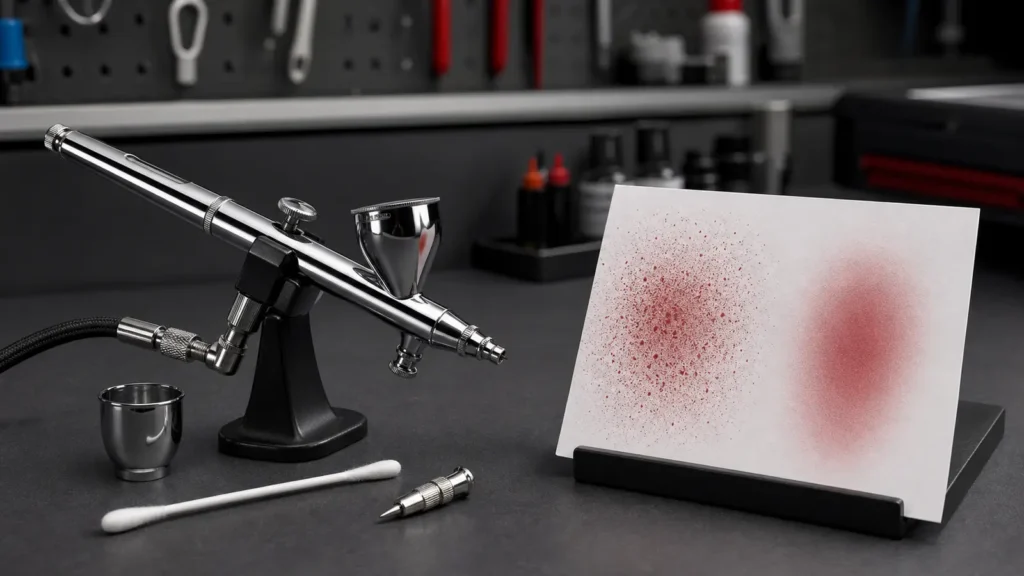
Airbrush pulsing after nozzle replacement is not proof that the new nozzle is defective. It may come from a mismatched needle taper, cap geometry, a seal disturbed during service, cleaner residue or a pressure condition that was not tested before the part change. Reinstall the confirmed original part only when safe, repeat the clean-liquid card and compare with the needle-nozzle pulsing check before approving a replacement packet.
A controlled installation and verification sequence
Isolate the air supply and follow the model’s service procedure. Confirm the replacement code before fitting, keep seating surfaces clean and use only the specified service tools. Handle the needle gently and stop if a component resists unexpectedly. Do not compensate for a poor fit with extra force, random sealant or improvised spacers.
After assembly, use a compatible clean liquid and then the intended prepared coating under a repeatable test sequence. Check start, continuous flow, stop and restart, and look for leakage or unintended backflow. Retain the result against the part code. Follow the cleaning and reassembly guidance for maintenance boundaries.
Build a distributor compatibility matrix
A useful spare-parts catalogue has one row per confirmed configuration: retail model, manufacturing revision, head-size option, needle code, nozzle code, cap/head code, included seals and source of confirmation. Add an effective date and an approved substitution field. Leave unknown combinations unapproved.
Avoid product listings headed “universal” unless the claim has a defined and documented scope. If a packet serves several models, list those exact models and applicable revisions. Separate individual replacement items from complete conversion kits so the buyer knows what is included.
For private-label kits, keep the customer-facing spare code linked to the factory component revision. Artwork can stay visually identical while an internal component changes. A documented substitution review helps prevent old service stock from being used on a new configuration without validation.
Create a spare-parts BOM before listing replacements
An airbrush needle nozzle spare parts matrix should be built from the approved bill of materials, not from a visual comparison after stock arrives. For distributors, the airbrush spare parts BOM is the control document that connects retail SKUs to factory component revisions.
| Distributor field | Minimum detail | Why it matters |
|---|---|---|
| Compatible model | Exact model, version and head-size configuration. | Prevents replacement packets from serving an unsupported revision. |
| Needle, nozzle and cap | Part codes, matched set rule and approved substitutions. | Separates single replacements from complete conversion kits. |
| Service label | Retail code, factory code, quantity, date and caution note. | Airbrush service parts labeling reduces picking errors in small parts. |
| Supplier evidence | Drawing, official parts list or written confirmation against the exact model. | Supports an airbrush replacement parts supplier checklist without guessing. |
When one replacement packet covers several models, list the approved models on the matrix and leave other combinations blank. A blank cell is better than an unsupported compatibility claim that later creates returns.
Buying replacement parts in bulk
Send the supplier the target models, current component codes, desired quantities, packaging format and whether the order is for replacement or conversion. Ask which combinations have been confirmed and what evidence supports that confirmation. Request clear identification on small-parts packaging and a method for separating similar sizes during packing.
Evaluate the first batch against a retained reference using the airbrush quality control checklist. Do not treat a visual match as a passed functional test. Also agree how discontinued components and future substitutions will be communicated to distributors.
Use warranty returns to improve the parts matrix
Airbrush warranty return diagnosis should record the model, part code, installation history, cleaning method, material used and symptom before a replacement is blamed. A leaking or pulsing airbrush after service may involve contamination, a damaged seal, an installation error or an incompatible replacement; the return record should keep those options separate.
Feed confirmed return findings back into the compatibility matrix. If several customers order a nozzle by diameter and report the same failure, the label, listing title or support note may need correction. If the returned part is damaged during installation, add safer handling instructions rather than changing the product claim.
Needle and nozzle compatibility FAQ
Can I use a needle from another brand if its diameter looks the same?
Only with documented compatibility for the exact configuration. Appearance and nominal size do not establish the taper, seat relationship, length or operating behavior.
Do I always need to replace the needle and nozzle together?
Not universally. Follow the model’s repair instructions and inspection findings. Some repairs allow a single part; some matched assemblies or conversions require several components.
Can a larger nozzle fix paint that keeps clogging?
A supported larger configuration may suit some materials, but first rule out dried residue, unsuitable preparation and a damaged component. It cannot correct every cause of intermittent flow.
Send the exact model and component references for a YIDIAN spare-parts quotation or compatibility review.
Replacement airbrush parts identification for a working studio
For a studio or teaching setup, identify the airbrush model revision before building a spare-parts list. Keep the model marking, part code, head configuration and a clear photograph together. Separate a confirmed replacement from a proposed conversion. If a code cannot be verified, describe it as unknown and ask for clarification rather than ordering by diameter alone.
The studio buying-brief builder helps you collect project context for a parts or equipment inquiry. It does not decide compatibility. Add the exact model and part references to the message and request written confirmation before ordering.
Manufacturer references: Iwata airbrush FAQ and model-specific parts finder. These references illustrate the identification method; they do not imply cross-brand parts compatibility.